1

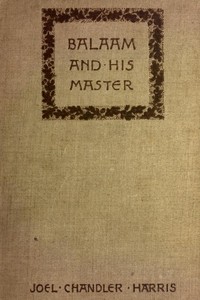
Balaam and His Master, and Other Sketches and Stories — Reading Companion
8
0
Project Gutenberg
2018
Short stories, American; United States -- Social life and customs -- 19th century -- Fiction
Readers of public-domain and historical texts
Project Gutenberg digital edition
en
Edition facts
Words: 62,275
Reading time: 271 min
Text sections: 6
Source:
Project Gutenberg record #56883
Joel Chandler Harris's 1891 collection of six stories, including the title piece about a man sold into slavery by his father, uses frame narratives and Southern dialect to explore post-Civil War social dynamics, with recurring motifs of violence, humor, and moral ambiguity.
Editorial Edition Score
4.7/5
★★★★★
★★★★★
Calculated from edition completeness, EPUB availability, text structure and catalogue metadata. Not a user rating.
Edition quality
The title story opens with a striking preface: 'What fantastic tricks are played by fate or circumstance!' This sets the tone for a collection where irony and moral complexity pervade. The narrative begins with the origin of 'Billville,' a Georgia settlement where nearly every man is named Bill, a comic detail that quickly darkens as the story unfolds. The frame narrator, a young boy traveling with a caravan, encounters a mysterious fiddler named Willis Featherstone, who reveals he was sold by his father to a slave speculator. This revelation, delivered as a riddle, anchors the story in the brutal realities of slavery and family betrayal.
The Frame Narrator and the Fiddler's Riddle
The opening sections establish a layered narrative structure. The unnamed boy narrator describes his journey with a mule caravan, where the fiddler Featherstone becomes his companion. Featherstone's skill on the fiddle 'entrance[s] the whole camp,' yet he is reserved, often playing only when in the mood. The boy's curiosity about Featherstone's past is met with a riddle: 'A father had a son. He sent him to school in Augusta, until he was fifteen. By that time, the father grew to hate the son, and one day, in a fit of anger, sold him to a nigger speculator.' The boy cannot solve it, but the reader is left to infer the horrifying truth. This indirect revelation is characteristic of Harris's method: he presents disturbing material through dialogue and implication rather than explicit description.
Setting and Atmosphere in the Sandhills
The camp near the Sandhills is described with precise sensory detail: 'a very bold spring, surrounded by live-oaks,' 'plenty of grass for the mules,' and a white house with green blinds set among magnolias and cedars. This idyllic scene contrasts sharply with the grim backstory. The boy notes that the house 'sat in the midst of a beautiful grove,' and the avenue was 'lined on each side with Lombardy poplars.' Such careful description grounds the story in a specific Southern landscape, while the tension between beauty and moral decay becomes a recurring motif. The narrator's memory of the place as 'impressed on my mind so vividly' suggests that what follows will be traumatic.
Violence and Amusement in the Caravan
Harris depicts the rough social life of the teamsters: they gather to 'egg them on, or sit by their fires and tell stories or play cards.' Fights are common, and 'the shotgun was mighty handy and the dirk was usually within reach.' Yet amid this violence, there is a strange normalcy—the men squeeze 'every amusement' from their circumstances. The boy's relationship with Featherstone is marked by mutual respect; the fiddler knows 'just how to handle the mules' and how to keep 'Crooked-leg Jake sober.' This juxtaposition of casual brutality and practical competence reflects Harris's unsentimental view of frontier life. The caravan serves as a microcosm of a society where violence and humor coexist.
The Riddle of Identity and Betrayal
Featherstone's riddle about a father selling his son is the emotional core of the excerpt. When the boy asks, 'How could that be?' Featherstone replies, 'That is a part of the riddle.' The boy's inability to solve it mirrors the reader's own struggle to comprehend such betrayal. The mother's absence is noted: 'Where was the son's mother?' 'In the riddle—in the riddle,' Featherstone answers. This evasion deepens the mystery. The boy concludes that 'some such villainy' must have occurred, but the full truth remains elusive. Harris uses this technique to engage the reader in active interpretation, resisting easy moralizing. The story promises that 'the things that actually happened were infinitely worse than any dream,' a foreboding hint of the narrative to come.
Readers should pay close attention to the frame narrator's perspective: his youth and naivety color the telling, and his gaps in understanding are intentional. Harris often withholds key information, forcing the reader to piece together the moral landscape. The collection's six stories vary in tone and subject, but the title piece sets a pattern of indirect revelation and layered storytelling. Approach each story as a puzzle where the surface details—a fiddler's song, a campfire tale, a chance remark—may conceal deeper truths about race, family, and survival in the postbellum South.
Reader reflection
Your personal reading reflection
Build a private reading journal entry for this title.
Your progress
0
/
10
2
What was your overall reaction to the book?
3
How likely are you to recommend this book?
4
How much effort did this book require?
5
Which element worked best for you?
6
How well did it match your expectations?
7
How distinctive were its ideas or approach?
8
Would you start a conversation about this book?
9
What is the main idea you are taking away?
10