
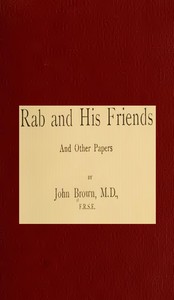
Horae subsecivae. Rab and His Friends, and Other Papers by John Brown
John Brown's Horae Subsecivae (which roughly means 'spare hours') is a collection of his essays and sketches, but the crown jewel is undoubtedly 'Rab and His Friends.' First published in 1859, it draws from Brown's life as a doctor in Edinburgh, giving it an authenticity that pure fiction often lacks.
The Story
The narrative is straightforward but deeply moving. We meet Ailie, a kind-hearted carrier's wife, and her constant companion, Rab, a giant, gentle mastiff. Their life is simple and content. The trouble starts when Ailie develops a tumor in her breast. In an era before modern anesthesia and antiseptics, surgery was a brutal, frightening ordeal. The story follows Ailie's brave decision to undergo an operation at the Edinburgh Infirmary, with Rab, confused and distressed, following her every step. The heart of the tale lies in the waiting room and the hospital courtyard, where Rab keeps his vigil. He can't understand the science or the pain, but he understands his person is in distress, and his silent, worried presence outside the surgical theater is one of the most poignant depictions of loyalty ever written.
Why You Should Read It
This isn't just a 'dog story.' Brown uses Rab's perspective to highlight the humanity—and sometimes the chilling clinical distance—of the medical world. The doctors are not villains; they are men of their time doing their best. But Rab, in his pure, instinctual worry, reminds us of the emotional cost that medicine often overlooks. The beauty is in the small details: Rab laying his head on Ailie's knee, the way the hospital porters nervously deal with him, the quiet dignity of Ailie herself. Brown writes with a doctor's eye and a poet's heart. He doesn't shy away from the harsh realities of 19th-century life, but he frames them with such compassion that the story feels timeless.
Final Verdict
This book is perfect for readers who love classic, character-driven narratives that pack an emotional punch without being manipulative. If you enjoy the works of authors like James Herriot or the quiet, observed humanity in George Eliot's smaller scenes, you'll connect with Brown's writing. It's also a fascinating slice of social and medical history. The other papers in the collection offer thoughtful musings on art, literature, and life, making the whole volume a delightful peek into a thoughtful 19th-century mind. But really, you'll come for Rab, and he will stay with you long after you've finished the last page.
You are viewing a work that belongs to the global public domain. Thank you for supporting open literature.
Sarah Lee
7 months agoThe citations provided are a goldmine for further academic study.
Robert Harris
9 months agoOne of the most comprehensive guides I've read this year.
Jessica Hernandez
9 months agoUnlike many other resources I've purchased before, the narrative arc keeps the reader engaged while delivering factual content. A refreshing and intellectually stimulating read.
Donald Wilson
11 months agoI decided to give this a try based on a colleague's recommendation, the author doesn't just scratch the surface but goes into meaningful detail. The insights gained here are worth every minute of reading.





Paul Johnson
1 year agoIf you're tired of surface-level information, the author’s unique perspective adds a fresh layer to the discussion. Top-tier content that deserves more recognition.