1

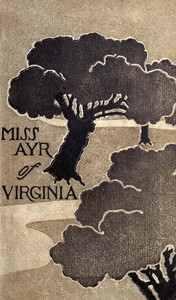
Miss Ayr of Virginia, & other stories — Reading Notes
8
1
Project Gutenberg
2024
Short stories, American; United States -- Social life and customs -- 19th century -- Fiction
Readers of public-domain and historical texts
Project Gutenberg digital edition
en
Edition facts
Words: 68,405
Reading time: 298 min
Text sections: 14
Source:
Project Gutenberg record #74718
Julia Magruder's 1896 collection of eight stories, including the title piece, examines post-Civil War Southern identity and class through precise social observation, recurring motifs of clothing and money, and movement between intimate and public spaces.
Editorial Edition Score
4.8/5
★★★★★
★★★★★
Calculated from edition completeness, EPUB availability, text structure and catalogue metadata. Not a user rating.
Edition quality
The opening of "Miss Ayr of Virginia" immediately establishes a central tension in Magruder's collection: the friction between inherited status and present circumstance. Miss Carter Ayr, a Virginia belle, is contrasted with her New York cousins through their dress—her "village-made costume" against their "chic" and "height." The discrepancy is not merely aesthetic; it signals a deeper shift in regional power after the war. Magruder's prose lingers on the physical details of clothing and bearing, using them as shorthand for social position. Throughout these eight stories, such concrete markers—a hat, a hundred-dollar gift, a disordered evening-dress—carry the weight of character and conflict.
Clothing as Social Cartography
Magruder repeatedly uses dress to map social terrain. In the title story, Miss Ayr's hat is described as "a complete handicap for a beautiful face," a phrase that turns fashion into an obstacle course. The cousins' maid's adjustments, which Miss Ayr "inwardly resented," show how even small sartorial concessions carry emotional cost. Later, in the excerpt from another story, Hertford appears in "disordered evening-dress" after a sleepless night—a detail that signals his inner turmoil without explicit statement. Clothing here is never neutral; it is a language of class, region, and psychological state.
Money and Its Discontents
Wealth appears as a persistent irritant. The Ayrs of Virginia are poor; the Ayrs of New York are rich, and the war is the cause. In a later story, Hertford is "intensely unpleasant" to discover that the woman he loves has money, and that she is the "Rich Lady" who gave a hundred dollars while her aunt gave one. The narrative tracks his struggle to accept her wealth, noting that "the money was the girl's, then." Magruder does not resolve this discomfort; she lets it sit, a splinter in the romance. The stories repeatedly stage scenes where money is given, counted, or resented, making economic disparity a quiet but constant pressure.
Movement Between Public and Private
The stories often pivot on a character's movement from one space to another. Miss Ayr descends to the coach for the races; Hertford leaves a ballroom, walks through a "magnificent drawing-room," and crosses a "grand hall." These transitions are not merely scenic. They mark shifts in power, knowledge, or emotion. Hertford's exit from the ball into the night, his later walk to Mrs. Etheridge's house, and his passage through her rooms all carry narrative weight. Magruder uses architecture—coaches, halls, drawing-rooms—as thresholds where characters confront what they know or fear.
Recurring Patterns of Observation
Magruder's narrator frequently steps back to note what characters do not realize. Miss Ayr "did not realize" how unbecoming her dress was; Hertford "forced himself to realize" the widow's past. This pattern of delayed or partial awareness creates a layered texture: the reader sees more than the characters do. The narrator also offers comparative judgments, as when the cousins are "partly right" about Miss Ayr's upbringing. These small editorial gestures give the stories a dry, observational quality, less invested in dramatic revelation than in the slow accumulation of social understanding.
Magruder's stories reward attention to the small, telling detail—the fit of a sleeve, the weight of a dollar, the pause in a doorway. They are not plotted around grand reversals but around moments of recognition, often incomplete. Readers may find it useful to track how each story opens and closes with a physical object or gesture, and to notice where the narrator withholds judgment or offers it obliquely. The collection as a whole builds a quiet, cumulative portrait of a society in transition, held together by the things people wear, give, and cannot forget.
Reader reflection
How did this book work for you?
Your answers remain private and are stored only in this browser.
Your progress
0
/
10
2
Was reading this book enjoyable?
3
Would you encourage someone else to read it?
4
Did the language feel accessible?
5
Did you gain anything practical from the text?
6
How clear did the writing feel?
7
How did the pace of the book feel?
8
Did you relate to its people, ideas, or situations?
9
What changed or sharpened your thinking?
10