1

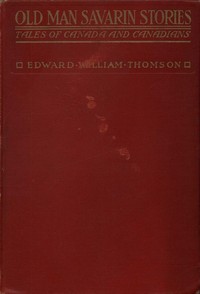
Old Man Savarin Stories: Tales of Canada and Canadians — Story, Setting & Ideas
5
0
Project Gutenberg
2017
Short stories, Canadian; Canada -- Social life and customs -- Fiction; Canadians -- Foreign countries -- Fiction
Readers of public-domain and historical texts
Project Gutenberg digital edition
en
Edition facts
Words: 69,447
Reading time: 302 min
Text sections: 9
Source:
Project Gutenberg record #55431
Edward William Thomson's 1917 collection blends dialect-rich dialogue, wry humour, and eerie folklore in tales of Canadian settlers, loggers, and soldiers. The opening poem and stories like 'Privilege of the Limits' and 'Red-Headed Windego' showcase shifts between nostalgic verse, oral storytelling, and suspenseful pacing.
The collection opens with a poem, 'The Canadian Abroad,' whose regular metre and rhyme evoke a sentimental longing for Canadian landscapes—'the croon of a rapid,' 'the scent of a pine-forest gloom.' This lyrical voice gives way abruptly to the vernacular of old Mrs. McTavish in 'Privilege of the Limits,' who begins, 'Yes, indeed, my grandfather wass once in jail.' The contrast between polished verse and dialect-heavy prose signals Thomson’s interest in multiple registers of Canadian speech. Later, in 'Red-Headed Windego,' the narrative pace tightens: short, panicked lines of dialogue—'I go back, me'—alternate with longer expository paragraphs, creating a rhythm of mounting tension. These shifts in voice and tempo are not merely stylistic; they shape how each story’s moral or mystery unfolds.
Dialect as Character and Conflict
Thomson renders French-Canadian and Scottish dialect with phonetic precision, but the effect is more than local colour. In 'Red-Headed Windego,' Big Baptiste’s speech—'Hain't I just seen de track?'—marks him as superstitious and fearful, while the surveyor Tom responds in standard English, using calm reasoning: 'There's no danger unless it's a fresh track.' Their linguistic difference mirrors a clash of worldviews: empirical logic versus inherited belief. The narrator does not resolve this tension; instead, the track’s ambiguous description—'five narrow holes' and 'an irregular drip or squirt of blood'—leaves both perspectives plausible. Similarly, old Mrs. McTavish’s Scots-inflected syntax ('wass a ferry honest man whateffer') lends her tale of debt and honour an oral authority that plain English might lack. Dialect here is not decoration but a tool for dramatizing cultural friction.
Pacing and the Supernatural
Thomson manipulates sentence length to control suspense. In 'Red-Headed Windego,' the discovery of the track unfolds in clipped, almost breathless fragments: 'Dere is blood at de bottom—I seen it!' Then the narrative expands into measured analysis: 'Tom mused over this information. These men had all been in Madore's shanty…' This alternation between urgent dialogue and reflective prose mimics the characters’ oscillation between panic and reason. The supernatural element—a Windego, a monster of Algonquian legend—is never confirmed; the story withholds resolution, ending instead on Tom’s suspicion of a human trick. The pacing thus mirrors the uncertainty: rapid, fearful exchanges give way to slower deduction, but no final answer arrives. Elsewhere, in 'Privilege of the Limits,' the pace is leisurely, anecdotal, with long paragraphs of reminiscence. The collection as a whole moves between these two speeds, offering both fireside yarn and taut thriller.
Recurring Motifs: Debt, Honour, and the Land
Several stories circle around promises and their cost. In 'Privilege of the Limits,' the grandfather’s refusal to break his word despite imprisonment establishes a moral code tied to personal honour rather than law. The opening poem, too, binds the speaker’s heart to 'the Ottawa hills'—a debt of memory. In 'Red-Headed Windego,' the surveyor Tom is bound by a vow to complete his job, even as his men threaten to desert. The landscape itself becomes a character that tests these commitments: the 'croon of a rapid,' the 'snow-shroud,' the 'track' that may be supernatural or man-made. Thomson’s Canada is not a backdrop but an active force that shapes speech, belief, and action. The recurring image of a 'faraway mountain' in the poem echoes through the prose as a horizon that characters either strive toward or flee from, binding the collection’s disparate voices into a shared geography of obligation.
Readers attentive to narrative voice will find Thomson’s collection a study in contrast: the formal cadence of its opening poem versus the raw immediacy of dialect; the slow build of anecdote versus the sharp cuts of supernatural suspense. These shifts are not inconsistencies but deliberate choices that reflect the varied textures of Canadian experience at the turn of the century. Approach each story as a self-contained experiment in tone, and note how Thomson uses pace—whether unhurried or urgent—to guide your response to the characters’ dilemmas.
Reader reflection
How did this book work for you?
Your answers remain private and are stored only in this browser.
Your progress
0
/
10
2
How did the book work for you overall?
3
Would you encourage someone else to read it?
4
How easy was the book to follow?
5
How strongly did the book affect you emotionally?
6
How original did the book feel?
7
What did you appreciate most?
8
Would you start a conversation about this book?
9
What changed or sharpened your thinking?
10