
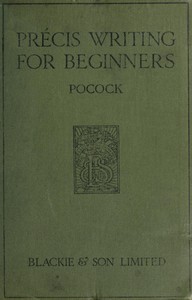
Précis writing for beginners by Guy Noel Pocock
Let's be clear from the start: this isn't a novel. Précis Writing for Beginners is exactly what the title says—a practical guide. Published in the shadow of World War I, it was written for students and professionals who needed to communicate with precision and efficiency. Guy Noel Pocock, a teacher and writer, walks you through the process step-by-step. He defines what a précis (a concise summary) is and, just as importantly, what it is not. Then, he provides example passages—often plucked from the newspapers and political speeches of his day—and shows you how to dissect them. He teaches you to find the core argument, strip away the supporting details and examples, and then rebuild the main point in your own, tighter words. It's a methodical exercise in active reading and clear writing.
Why You Should Read It
You should read this because it's shockingly relevant. In our age of information overload, the ability to distill a complex report, a long email thread, or a client's rambling request into a few clear sentences is a superpower. Pocock's lessons are timeless: identify the main idea, eliminate repetition, and use direct language. Reading his 1918 examples about tariffs or naval power is a fun history lesson, but the technique translates perfectly to summarizing a modern business article or a podcast episode. The book's charm lies in its direct, no-nonsense voice. It feels like having a smart, slightly old-fashioned coach in your corner, patiently reminding you that good thinking requires clear expression.
Final Verdict
This book is a perfect little toolkit for students, writers, managers, or anyone whose job involves processing and relaying information. It's also a fascinating read for history or language nerds who enjoy seeing how the fundamentals of good communication haven't really changed in a century. If you're looking for a fast-paced story, look elsewhere. But if you want to sharpen a crucial, under-taught skill in under an hour, Pocock's vintage guide delivers. Think of it less as a textbook and more as a conversation with a very clear-headed ghost from the past.
The copyright for this book has expired, making it public property. It is now common property for all to enjoy.
Joshua Flores
1 year agoAmazing book.