
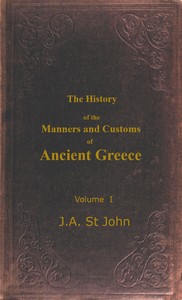
The History of the Manners and Customs of Ancient Greece, Volume 1 (of 3)
Forget the dry dates and battle maps you might remember from school. The History of the Manners and Customs of Ancient Greece is a different kind of history book. Instead of focusing on kings and conquests, author James Augustus St. John gets down to the nitty-gritty of daily life in the ancient world. Think of it as a massive, well-researched time-travel guide.
The Story
There isn't a traditional plot with characters. The "story" is the reconstruction of an entire way of life. St. John starts from the ground up. He describes the Greek home, from the architecture to the simple furniture. He talks about family life—how marriages were arranged, how children were educated (boys very differently from girls), and the complex relationships within a household. The book covers what people wore (hint: it wasn't always a fancy toga), what they ate (a surprisingly simple diet), and how they cooked it. It goes into their jobs, their religious rituals, their festivals, and even their games and sports. It paints a complete, vivid picture of the rhythm of life from morning to night, from birth to death.
Why You Should Read It
This book makes the ancient Greeks feel real. When you learn that a philosopher might have debated the nature of justice while wearing a simple woolen cloak and eating olives, it changes things. You start to see their world not as a collection of marble ruins, but as a living, breathing place. I loved seeing how their customs explained their history. Their fierce sense of competition in games mirrored their politics. Their strict social rules for women help explain certain myths and plays. It connects the dots between the kitchen and the Acropolis. It’s surprisingly relatable in parts, and wonderfully strange in others.
Final Verdict
This is perfect for anyone curious about history but tired of military timelines. It's for the reader who loves documentaries about everyday life in other eras, or for novelists and role-players who want authentic details for their stories. Be warned, it's a dense, Victorian-era work, so the language is formal and it's packed with information—it's a slow, rewarding sip, not a quick gulp. But if you want to truly understand the people who gave us democracy, drama, and the Olympics, this book is an essential and fascinating foundation. You'll never look at a Greek statue the same way again.
This publication is available for unrestricted use. It is now common property for all to enjoy.
Nancy Davis
6 months agoI found the author's tone to be very professional yet accessible, the clarity of the writing makes even the most dense sections readable. A mandatory read for anyone in this industry.
Susan Harris
6 months agoI started reading this with a critical mind, the visual layout and supporting data make the reading experience very smooth. I'm glad I chose this over the other alternatives.
Jennifer Gonzalez
2 years agoI was skeptical about the depth of this book at first, but the way the author breaks down the core concepts is remarkably clear. It definitely lives up to the reputation of the publisher.
Karen Lopez
2 years agoIt’s refreshing to see such a high standard of digital publishing.









Barbara Harris
1 year agoI was skeptical about the depth of this book at first, but the argument presented in the middle section is particularly compelling. Truly a masterpiece of digital educational material.