1

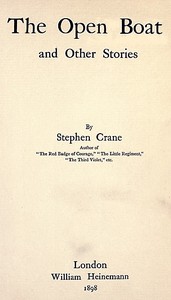
The Open Boat and Other Stories — Story, Setting & Ideas
4
0
Project Gutenberg
2014
Short stories, American; United States -- Social life and customs -- 19th century -- Fiction
Readers of public-domain and historical texts
Project Gutenberg digital edition
en
Edition facts
Words: 69,690
Reading time: 303 min
Text sections: 24
Source:
Project Gutenberg record #45524
Stephen Crane's 1898 collection juxtaposes survival at sea, frontier violence, and urban misery through compressed, image-driven prose. The title story tracks four men in a dinghy; other pieces shift from Texas saloons to New York streets, using recurring motifs of indifferent nature, mechanical failure, and social performance.
Editorial Edition Score
4.8/5
★★★★★
★★★★★
Calculated from edition completeness, EPUB availability, text structure and catalogue metadata. Not a user rating.
Edition quality
The collection opens with men who cannot see the sky because their eyes are fixed on the waves. That visual constraint—a horizon that narrows and widens, dips and rises—sets the pattern for the stories that follow. Crane repeatedly places characters in situations where perception is limited, whether by fog, darkness, or social ritual. The dinghy in the title story is measured against a bathtub; the men are defined by what they can touch and what threatens to overwhelm them. Throughout the volume, Crane builds scenes from physical details—the six inches of gunwale, the rolled sleeves of the cook, the thin little oar—and lets those details carry the emotional weight.
The structure of the book reinforces this method. The first part, “Minor Conflicts,” groups tales of overt danger: shipwreck, gunfire, a filibustering expedition. The second part, “Midnight Sketches,” turns to quieter but no less acute pressures—poverty, shame, the awkwardness of youth. The shift in scale is deliberate, and the reader is asked to see the same attention to gesture and environment applied to a dance at an inn as to a sinking steamer.
The Weight of a Single Detail
Crane’s prose works by accumulation of small, exact observations. In “The Open Boat,” the cook’s unbuttoned vest flaps as he bails; the oiler’s oar seems ready to snap. These details are not decorative—they define the physical reality of the boat and the men’s relation to it. The same method appears in “Horses,” where a servant’s crimson serape flames against the dusk of the mesquite, and the sky is described as a “marvellous tone of green—like still, sun-shot water.” The simile is precise, but it also echoes the sea of the opening story, linking the two landscapes through color and texture.
In the “Midnight Sketches,” the details shift from natural to urban. A man’s unbuttoned vest becomes a different kind of exposure; the “great toppling sombrero” of a servant is replaced by the hats of men in a storm. Crane does not explain—he shows the reader what the eye would see, and lets the scene generate its own meaning.
Movement Between Elements
The stories are built on transitions—from sea to land, from ship to dance floor, from wilderness to town. In “The Open Boat,” the narrative moves from the dinghy to the hotel where a dance is interrupted by news of the wreck. The contrast is stark: the fountain splashes softly, lamps throw rose light on palm leaves, and a girl complains of damp sand. Crane cuts between the two spaces without commentary, letting the juxtaposition create the irony.
“Flanagan and His Short Filibustering Adventure” offers a similar pivot. The engine room is described as a place of “terrified machinery” and “unearthly stillness”; the crew rolls their eyes “like hurt cows.” Then the scene shifts to the deck, where the captain understands “doom and its weight and complexion.” The movement is not just spatial but tonal—from mechanical chaos to a quiet, almost domestic image of the ship settling “as calmly as an animal curls down in the bush grass.”
Recurring Images of Indifference
Several stories share a vocabulary of indifference. The sea in “The Open Boat” is not hostile but simply indifferent—the waves are “most wrongfully and barbarously abrupt,” but the wrongfulness is felt by the men, not the water. The same quality appears in “Horses,” where the landscape is vast and the servant follows “in the fashion of an assassin.” The natural world does not respond to human need.
In the “Midnight Sketches,” the indifference is social. A crowd gathers at the beach, but the women’s perfume floats over the scene; later, a body floats in. The dance continues until news arrives, and even then the guests are more concerned with their own comfort. Crane’s eye for the trivial alongside the catastrophic—the girl who pouts because she cannot go to the beach, the man who admires a woman while a wreck is happening—creates a pattern of human self-absorption that mirrors the sea’s neutrality.
Voice and the Limits of Speech
Crane’s characters often communicate through minimal, repeated phrases. The cook’s “Gawd! That was a narrow clip” becomes a refrain, a verbal tic that marks the passage of time. In “Flanagan,” the crew obeys “the Voice”—not a specific command but the sound of authority itself. The captain, after the ship sinks, sobs and swears, but the words are less important than the act of breaking down.
Dialogue in the “Midnight Sketches” is similarly compressed. A girl says, “Oh, dear! supposin’ they were out there drowning while we were dancing!” Her brother answers, “Oh, nonsense! that don’t happen.” The exchange is almost too brief to carry the weight of the situation, but that is the point—language fails to bridge the gap between the dance and the drowning. Crane trusts the reader to hear what is not said.
Reading these stories in sequence reveals a writer testing the limits of his method. The same attention to physical detail that makes the dinghy real also makes the dance floor vivid; the same indifference that governs the sea governs the social world. Crane does not resolve the tension—he lets the images stand. The reader is left to move between the two poles, noticing how the same patterns recur in different settings. The collection rewards a slow reading, one that pauses on the color of a serape or the sound of a single oar.
Reader reflection
Record your reading impressions
A brief reflection can help important ideas stay with you longer.
Your progress
0
/
10
2
How did the book work for you overall?
3
Is this a title you would suggest to others?
4
Did the language feel accessible?
5
Would you start a conversation about this book?
6
Would you read this book again?
7
What did you think about the pace?
8
How much did the book move you?
9
What did this book teach you most?
10