1

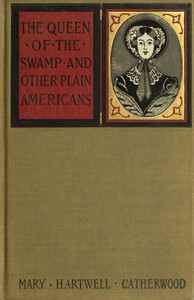
The Queen of the Swamp, and other plain Americans — A Reader’s Guide
9
1
Project Gutenberg
2024
United States -- Social life and customs -- Fiction; Short stories, American
Readers of public-domain and historical texts
Project Gutenberg digital edition
en
Edition facts
Words: 55,437
Reading time: 242 min
Text sections: 19
Source:
Project Gutenberg record #74271
A collection of short stories set in Ohio, Kentucky, Indiana, and Illinois, capturing late-19th-century middle-western life through precise regional detail. The author's note describes them as preserving 'phases of American life which have entirely passed away.'
Editorial Edition Score
4.8/5
★★★★★
★★★★★
Calculated from edition completeness, EPUB availability, text structure and catalogue metadata. Not a user rating.
Edition quality
Mary Hartwell Catherwood's The Queen of the Swamp, and other plain Americans (1899) collects fourteen stories written over more than a dozen years, originally published in periodicals such as the Atlantic Monthly, Harper's Bazar, and the Chicago Tribune. The author's own note frames the volume as an 'honest preservation of middle western experience,' claiming that many stories embody 'phases of American life which have entirely passed away.' The table of contents organizes the tales by state—Ohio, Kentucky, Indiana, Illinois—suggesting a deliberate geographical structure. The excerpts reveal a writer attentive to vernacular speech, local custom, and the emotional weight of ordinary lives, from a Christmas quarterly meeting in 1846 to a train accident that kills a deaf-mute boy.
Regional Framing and the Catalog's 'Plain Americans'
The catalog subjects—'United States -- Social life and customs -- Fiction' and 'Short stories, American'—are accurate but broad. Catherwood's subtitle, 'and other plain Americans,' signals a focus on unpretentious, rural or small-town characters. The excerpts bear this out: the opening story, 'The Queen of the Swamp,' begins with a Methodist quarterly meeting in Ohio in 1846, describing the presiding elder and his assistants 'wrapping up their throats and joking with each other.' The author's note explicitly contrasts the Puritan and Church of England settlement of the Atlantic coast with the Methodist itinerant as 'the pioneer evangelist of the Middle West.' This regional specificity—Ohio, Kentucky, Indiana, Illinois—is more precise than the catalog's national framing. The stories are not generic 'American' tales but rooted in particular landscapes and historical moments, such as the 1846 setting of the title story or the 1883 pastoral 'T'Férgore.'
Voice and the Handling of Tragedy
Catherwood's prose in the excerpts is notable for its restrained, almost documentary treatment of disaster. In the story excerpted without a title in the provided text, a boy named Willie Harbison is killed by a train. The narration avoids melodrama: 'He was not mangled. His bones were sound—she felt them with a fiercely quick hand. There was no mark about him excepting a dirty-looking spot on one temple.' The mother's grief is conveyed through action—'she started from the house without speaking another word, and ran'—rather than interior monologue. The engineer 'wept out loud' and the train moves on. The story then shifts to a reflective passage: 'But only his mother—when she had him at home lying in that pomp of death with which we all shall impress beholders—could have pronounced the true oration over him.' This combination of stark external detail and sudden philosophical reach is characteristic of the voice in these excerpts.
The Unfinished Story: 'T'Férgore' and the Limits of the Excerpts
The excerpts include the beginning of 'T'Férgore,' subtitled 'A Pastoral in Three Parts' and set in 1883. It opens with a dialogue between Julian and an unnamed female narrator: 'Come into the painting-room,' said Julian, 'and let's talk it over.' The narrator is married to Julian, and they discuss a trip to Europe. The passage is brief—only a few paragraphs—and breaks off before the story develops. The epigraph from Samuel Johnson's Rasselas ('each laboring for his own happiness by promoting within his circle, however narrow, the happiness of others') hints at a theme of contentment within limits, but the excerpt provides no plot or resolution. Readers should note that this story, like several others in the collection, is only partially represented in the provided text. The catalog's classification as 'Historical, Psychological & Social Fiction' may apply unevenly across the fourteen stories.
The excerpts offer a sample of Catherwood's range—from a Christmas church gathering to a train accident to a painter's studio. The collection's arrangement by state invites reading as a mosaic of regional life, but the stories were written and revised over many years, and their tones vary. The author's own note warns that some 'phases of American life' depicted have 'entirely passed away,' making the volume a document of customs and settings now historical. Readers interested in the intersection of local-color fiction and turn-of-the-century magazine publishing will find this a rich, if uneven, collection.
Reader reflection
How did this book work for you?
Your answers remain private and are stored only in this browser.
Your progress
0
/
10
2
What was your overall reaction to the book?
3
Would you recommend this book to another reader?
4
How easy was the book to follow?
5
How did the reading compare with what you expected?
6
How strong was your personal connection to the text?
7
How useful did the reading feel?
8
Did this book create an emotional response?
9
What is the main idea you are taking away?
10