1

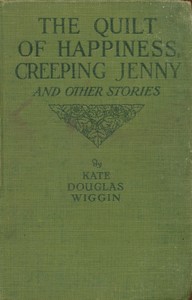
The quilt of happiness; Creeping Jenny; and other New England stories — Key Ideas to Explore
9
1
Project Gutenberg
2022
Short stories, American; New England -- Social life and customs -- Fiction
Readers of public-domain and historical texts
Project Gutenberg digital edition
en
Edition facts
Words: 29,480
Reading time: 129 min
Text sections: 3
Source:
Project Gutenberg record #69395
In this collection of New England stories, Kate Douglas Wiggin uses a brisk, colloquial narrative voice and shifts between domestic realism and sentimental comedy. The excerpts show characters bargaining over shingles and wedding dresses, with dialogue that reveals social codes and emotional restraint.
Editorial Edition Score
4.5/5
★★★★★
★★★★★
Calculated from edition completeness, EPUB availability, text structure and catalogue metadata. Not a user rating.
Edition quality
The opening of "Creeping Jenny" establishes a narrative voice that is both matter-of-fact and slyly humorous. Jenny Lane lives in a shabby farmhouse, but inside she is "Master of her fate and Captain of her soul"—a lofty echo that contrasts sharply with her leaky roof. The father’s dying words are not about love but about shingles: "I'd feel better if only I'd left you shingled." This blend of practical worry and dry wit sets the tone for the collection, where emotional weight is often carried by concrete objects and understated dialogue.
Dialogue as Bargaining and Bonding
The excerpts reveal a pattern where characters express affection and anxiety through negotiations over material things. Jenny’s father frets about the roof; Jenny responds with a mock-romantic ultimatum: "Shingle the house and I'll say yes!" Later, in the quilt-making scene, Rebecca reports that Miss Dearborn offered her pink delaine dress as a quilt lining after becoming engaged. The dress is both a token of happiness and a practical donation. When Rebecca worries whether the gentleman is trustworthy, Miss Dearborn laughs and removes the dress "right off her back." The dialogue moves between earnest concern and playful exaggeration, with characters often speaking in short, rhythmic sentences that mimic oral storytelling.
Narrative Pace and the Quilt as Structural Motif
The quilt of happiness functions as a narrative device that gathers multiple voices and stories. In the excerpt, Rebecca’s excited telling of Miss Dearborn’s engagement slows the pace with detailed description: the dress with "moss rosebuds," the rocking-chair laughter, the kiss on the waist. Emma Jane’s literal-minded question—"Kissed her waist? Wha' for?"—creates a comic pause, and Rebecca’s exasperated reference to Ivanhoe and sentimental novels highlights generational differences in emotional literacy. The quilt itself becomes a repository for these layered reactions, stitching together the practical and the romantic.
Voice and Regional Identity in Short Fiction
Wiggin’s narrative voice shifts between a standard literary register and regional dialect, often within the same paragraph. The father’s speech is marked by contractions and dropped consonants: "'Tisn't so easy to earn your living and keep your buildings shingled too!" The children’s dialogue includes grammatical quirks like "Wha' for?" and "I wisht." Yet the narrator’s own commentary is more polished, creating a subtle distance between the characters’ vernacular and the authorial perspective. This dual voice gives the stories a sense of affectionate observation without condescension, and it allows the pace to vary from brisk exposition to leisurely, dialect-heavy conversation.
Readers will find that the collection rewards attention to small details—a shingle, a dress, a quilt square—that carry emotional and narrative weight. The stories are best approached as linked vignettes rather than a continuous plot, with each piece offering a different angle on New England life at the turn of the century. The dialogue rewards reading aloud, as Wiggin’s ear for regional speech gives the prose a distinctive rhythm.
Reader reflection
Your personal reading reflection
Build a private reading journal entry for this title.
Your progress
0
/
10
2
What was your overall reaction to the book?
3
How likely are you to recommend this book?
4
How demanding did the text feel?
5
How would you describe its reading pace?
6
Could you follow the author’s main argument?
7
Did anything about the book feel genuinely new?
8
Did the book give you something worth debating?
9
What did this book teach you most?
10