1

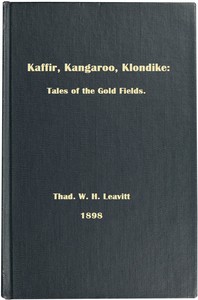
Kaffir, Kangaroo, Klondike: Tales of the Gold Fields — A Closer Reading
9
1
Project Gutenberg
2014
Short stories; Gold mines and mining -- Fiction
Readers of public-domain and historical texts
Project Gutenberg digital edition
en
Edition facts
Words: 29,850
Reading time: 130 min
Text sections: 3
Source:
Project Gutenberg record #47695
This collection of seven short stories uses frame narratives, dialect, and precise sensory details to depict gold rushes in Australia, New Zealand, and the Klondike. Leavitt contrasts the lure of wealth with moral lessons, often through supernatural or ironic twists.
Editorial Edition Score
4.5/5
★★★★★
★★★★★
Calculated from edition completeness, EPUB availability, text structure and catalogue metadata. Not a user rating.
Edition quality
Leavitt opens 'A Strange Partner' with a frame narrative: a passenger on a P&O steamer recounts his story in the smoking room. The tale begins with Henry Detmold, a bank clerk who resigns after reading about gold in Western Australia. The prose quickly establishes a contrast between the 'meagre salary' of eighty pounds a year and the 'thermometer at 120 degrees in the shade' of the desert. Detmold's journey to Coolgardie is described as a 'wilderness of tents and fleas, with absence of water,' a blunt, sensory detail that grounds the adventure in discomfort rather than romance.
Frame Narratives and Oral Storytelling
Several stories in the collection employ a frame narrative, a device that distances the reader from the action while lending authenticity. In 'A Strange Partner,' the narrator hears the tale from Detmold in a smoking room; in 'The Black Cat of Klondike,' a similar structure appears. This technique allows Leavitt to present extraordinary events—such as a ghostly cat or a mysterious partner—as secondhand accounts, which can be accepted or doubted. The storytelling voice often shifts to colloquial speech: Detmold says, 'I give it in his own words,' and the text includes phrases like 'a few followed his counsel and found peace.' These choices create a sense of oral tradition, as if the tales are being told around a campfire.
Diction of Disenchantment and Danger
Leavitt's word choice repeatedly undercuts the glamour of gold seeking. In 'A Strange Partner,' Coolgardie is a 'wilderness of tents and fleas,' and the prospector's country is 'a land of sand and heat.' The narrator notes that 'for shame and the knowledge that my position in the bank had long since been filled, I would have turned back.' This diction emphasizes regret and hardship. In the Maori legend, the wise man's message—'Eat not of human flesh,' 'Help one another,' 'Be content with your lot'—is delivered in stark, imperative sentences. The repetition of these phrases, like a refrain, reinforces a moral lesson that contrasts with the greed driving the gold seekers.
Supernatural and Symbolic Elements
The collection incorporates supernatural motifs that serve as moral or cautionary devices. In 'The Black Cat of Klondike,' a spectral cat appears; in 'The Skeleton Mine,' the title suggests a grim discovery. The Maori legend excerpt features a 'white bird' with 'eyes soft and full of tenderness' that leads a wise man to a mysterious lake and island. The island has 'three equal sides' and a single landing place, a geometric detail that hints at symbolic order. The wise man's journey involves 'no hunger' despite lack of food, and the lake water is 'almost boiling.' These elements—the bird, the hot spring, the boat with three seats—create a mythic atmosphere that Leavitt uses to explore themes of trust and revelation.
Setting as Character: Heat, Dust, and Isolation
Leavitt renders settings with precise, physical details that shape the characters' experiences. In the Australian story, the desert is a 'desert of sand' that the protagonist must walk, with his box riding on the stage. The heat is oppressive: 'thermometer at 120 degrees in the shade.' Coolgardie offers 'absence of water.' In the Maori legend, the landscape includes 'ferns with leaves of silvery whiteness' and 'cliffs rising from the water higher than twenty Kauri pines.' These details are not merely decorative; they create obstacles and wonders that drive the plot. The contrast between the barren gold fields and the lush, mysterious valley of the legend highlights the range of Leavitt's geographical imagination.
Readers should attend to how Leavitt uses the frame narrative to blur the line between fact and fiction. The stories reward attention to dialect, sensory description, and the recurring tension between material gain and moral integrity. Because the excerpts are incomplete, the full arc of each tale remains unknown, but the patterns of diction and structure offer a consistent authorial voice.
Reader reflection
What was your reading experience?
Capture what you thought, learned, and would like to remember.
Your progress
0
/
10
2
How much did you enjoy the reading experience?
3
Would you pass this book on to a friend?
4
How easy was the book to follow?
5
Would you like to discuss this book with someone?
6
Would you read this book again?
7
Did this book create an emotional response?
8
Did anything about the book feel genuinely new?
9
What changed or sharpened your thinking?
10
![Cover of Seven Men [Excerpts] — Background and Themes](https://eqopi.com/storage/media/covers/pg1306.jpg)
![Cover of Back to back [Night watches, Part 1.] — Key Ideas to Explore](https://eqopi.com/storage/media/covers/pg12151.jpg)
![Cover of The unknown [Night watches, Part 7.] — Story, Setting & Ideas](https://eqopi.com/storage/media/covers/pg12157.jpg)