1

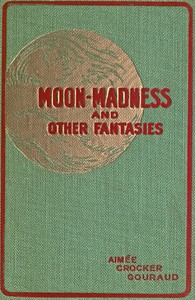
Moon-madness, and other fantasies — Story, Setting & Ideas
9
1
Project Gutenberg
2022
Short stories, American; Women -- Fiction
Readers of public-domain and historical texts
Project Gutenberg digital edition
en
Edition facts
Words: 12,836
Reading time: 56 min
Text sections: 11
Source:
Project Gutenberg record #68685
Eight short stories from 1910, each built around a striking visual or object—a painted portrait, a pearl necklace, a cobra dance—that triggers obsessive desire, power struggles, or supernatural undertones. Gouraud's prose is direct, repetitive, and theatrical, with scenes often pivoting on charged dialogue and abrupt shifts between Paris, India, and other exotic settings.
Editorial Edition Score
4.7/5
★★★★★
★★★★★
Calculated from edition completeness, EPUB availability, text structure and catalogue metadata. Not a user rating.
Edition quality
The collection opens with a man transfixed by a shop-window portrait of a woman with “red lips” so vivid they seem unnatural. That image—a painted face that appears to turn, look, and smile at the viewer—sets the pattern for the eight stories that follow. Each tale is anchored by a single, potent object or gesture: a pearl necklace, a cobra’s dance, a painted Mrs. Perry, a faithful servant named Kara. Gouraud’s prose is lean and repetitive, building tension through short declarative sentences and staccato dialogue. Scenes shift abruptly from Parisian art dealers to Indian palaces, but the underlying structure remains constant: a character becomes fixated on something—or someone—and the story spirals into obsession, refusal, or surrender.
Recurring Visual Anchors
Nearly every story in Moon-Madness and Other Fantasies is organized around a single, sharply described visual element. In “Our Lady of Red Lips,” the narrator dwells on the woman’s “creamy white” complexion, “inky black” hair, “dark green” eyes, and above all her “bright red” lips—repeating the color scheme until it becomes almost hypnotic. “Paula Loved Pearls” similarly fixates on the titular gems, while “The Dance of the Cobra” centers on the movement of a snake. These anchors are not merely decorative; they drive the plot. The man in the first story enters the shop because of the lips; Paula’s love of pearls determines her fate. Gouraud often returns to the same descriptive phrases, as if the object itself is casting a spell over the narrative.
Dialogue as a Mechanism of Power
Gouraud’s stories advance almost entirely through dialogue, and that dialogue is structured as a series of short, repetitive exchanges that escalate into confrontations. In “Kara the Faithful,” the Ranee and Kara speak in clipped lines: “I love you!” / “I—must—go!” / “Why?” / “I am a servant.” The repetition of “my lady” and “I serve—him” turns the conversation into a ritual of refusal. The same pattern appears in “Our Lady of Red Lips,” where the art dealer and the customer trade questions about the dead painter. Each reply is a single sentence, often a near-echo of the previous line. This technique creates a rhythm of tension and release, with power shifting between speakers as one character insists and the other resists.
Movement Between Exotic Settings
The stories leap from Paris to India to unspecified “exotic” locales with little transition. “Our Lady of Red Lips” begins with a man on a Paris street; “Kara the Faithful” unfolds in a Rajah’s palace; “Betty and Buddha” suggests an Eastern temple. Gouraud does not describe these settings in detail—a few words (“the place was Paris,” “the Ranee’s chamber”) suffice. The effect is that each story feels like a stage set, a backdrop for the central confrontation. The movement is abrupt: a character is in one place, then another, with no travel or explanation. This structural choice emphasizes the dreamlike, almost theatrical quality of the fantasies, where geography is less important than the charged encounter between two people.
The Unreliable or Incomplete Frame
Several stories rely on a frame that is only partially revealed. In “Our Lady of Red Lips,” the art dealer tells a tale of a painter who died “under peculiar circumstances,” and the customer presses for details—but the excerpt breaks off before the full story is told. Similarly, “Kara the Faithful” ends with the Ranee threatening Kara with a dungeon, but the resolution is cut short. These incomplete frames are not accidents of the excerpt; the table of contents lists eight stories, and the surviving text suggests that Gouraud often withholds the final outcome, leaving the reader to imagine the consequences. This structural ambiguity is a deliberate feature: the fantasies are meant to linger, unresolved, like the painted lips that continue to smile after the viewer has walked away.
Because the excerpts are incomplete, readers should approach each story as a fragment—a single scene or a handful of scenes that build to a moment of crisis rather than a full resolution. Gouraud’s strength lies in the intensity of that moment: the refusal, the kiss, the threat, the obsession. Pay attention to what is repeated and what is left unsaid; the gaps in the dialogue and the abrupt shifts in setting are part of the design. These are fantasies of desire and power, told in a style that is as stark and vivid as the red lips that begin the collection.
Reader reflection
How did this book work for you?
Your answers remain private and are stored only in this browser.
Your progress
0
/
10
2
How did the book work for you overall?
3
How likely are you to recommend this book?
4
What was the reading difficulty like?
5
How valuable was this book for your own interests?
6
Did anything about the book feel genuinely new?
7
How closely did the book connect with your experience?
8
What did you appreciate most?
9
What did this book teach you most?
10
![Cover of Seven Men [Excerpts] — Background and Themes](https://eqopi.com/storage/media/covers/pg1306.jpg)

![Cover of Back to back [Night watches, Part 1.] — Key Ideas to Explore](https://eqopi.com/storage/media/covers/pg12151.jpg)
![Cover of The unknown [Night watches, Part 7.] — Story, Setting & Ideas](https://eqopi.com/storage/media/covers/pg12157.jpg)