1

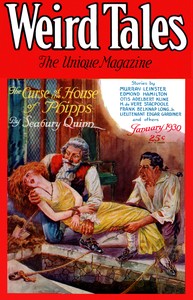
The murderer — A Closer Reading
11
1
Project Gutenberg
2024
Short stories; Murderers -- Fiction
Readers of public-domain and historical texts
Project Gutenberg digital edition
en
Edition facts
Words: 5,875
Reading time: 26 min
Text sections: 1
Source:
Project Gutenberg record #73612
In Murray Leinster's 1929 story, a murderer returns to the scene of his crime and is unnerved by a sound in the dark—only to discover it is a cat playing. The narrative shifts from psychological terror to dark comedy, with the cat's actions later confounding a coroner's inquest.
Editorial Edition Score
4.4/5
★★★★★
★★★★★
Calculated from edition completeness, EPUB availability, text structure and catalogue metadata. Not a user rating.
Edition quality
The story opens with the murderer's visceral fear: his hair lifts, a crawling sensation spreads down his spine, and he hears something moving in the pitch-dark room where he killed a man half an hour earlier. The prose dwells on his acute senses—the acrid reek of burnt powder, the staling scent of his own cigarette—and the sound that seems to come from the dead man's chair. This is not a whodunit but a study of a killer's unraveling nerves, rendered in Leinster's taut, sensory prose.
Yet the story pivots: the source of the sound is a large pet cat, playfully batting at the tablecloth. The murderer's terror becomes absurd, and the narrative tone shifts from horror to wry humor. The cat's antics later annoy the coroner during the inquest, when it causes a cigarette to burn his pocket. The catalog subjects—"Short stories; Murderers—Fiction"—fit, but the excerpts reveal a story less about murder than about the gap between a killer's dread and a mundane, comic reality.
A Killer's Heightened Senses
The excerpts dwell on the murderer's hyperawareness. He notes "the faint acrid reek of burnt smokeless powder," the "staling scent of the cigarette," and even "the curious humming of the telephone wires." This sensory overload is a hallmark of Leinster's style: the killer's guilt manifests as a kind of super-perception, making every detail ominous. The darkness is described through "vague rectangles of faint grayishness" where windows open onto the rainy night. These details ground the terror in the physical world, not the supernatural.
Yet the story undercuts this intensity. The murderer's fear is real, but the cause is a cat. The narrative voice remains detached, describing the cat's "playful pounces" and the sound like "a man drumming softly." The contrast between the killer's internal horror and the external banality creates a darkly comic tension.
The Cat as Comic Foil
The cat is the story's true agent of chaos. It first appears as a sound—"such a sound as might have been made by a man drumming softly"—that the murderer interprets as the dead man stirring. Later, it pulls at his trousers and makes him scream. The cat's actions are described with playful verbs: "buffeted," "playful pats," "sank its claws." This language contrasts sharply with the earlier horror vocabulary.
At the inquest, the cat's mischief continues. It causes the coroner's cigarette to fall into his pocket, burning him. The coroner's joke—"If that cigarette had been in its case, now"—is the story's punchline. The cat, not the murderer, drives the plot's resolution. The excerpts suggest the story is less about crime and punishment than about how trivial accidents derail official proceedings.
Structure: From Terror to Farce
The story's structure is a deliberate arc from psychological horror to absurdist comedy. The opening paragraphs build dread through repetition: "Something moving in the room!" and "Something alive in the room. Something furtive and horrible and—and terribly playful!" The murderer's physical reactions—"clench his teeth," "cold sweat," "sick with fear"—are described in detail.
Then the revelation: the cat. The tone shifts abruptly. The murderer's scream becomes "sickly, terrified" rather than purely terrified. The final scene, the inquest, is almost farcical: the coroner annoyed by a cat batting his coat-tails. The story does not moralize or explain the murder; it simply presents the killer's terror and the cat's indifference. This structural pivot is the story's most distinctive feature.
Readers should attend to how Leinster balances two registers: the murderer's overwrought interiority and the cat's mundane physicality. The story rewards attention to sound—the drumming, the purring, the humming wires—as a motif that bridges the killer's fear and the cat's play. The excerpts do not reveal the murderer's fate or the crime's motive; the story remains focused on the moment of terror and its deflation. Approach it as a study in tonal contrast rather than a conventional mystery.
Reader reflection
How will you remember this book?
Save your reaction, strongest insight, and memorable passage.
Your progress
0
/
10
2
Did this book hold your interest?
3
Would you pass this book on to a friend?
4
How demanding did the text feel?
5
What did you think about the pace?
6
Would you like to discuss this book with someone?
7
Would you read this book again?
8
How valuable was this book for your own interests?
9
What changed or sharpened your thinking?
10
![Cover of Seven Men [Excerpts] — Background and Themes](https://eqopi.com/storage/media/covers/pg1306.jpg)

![Cover of Back to back [Night watches, Part 1.] — Key Ideas to Explore](https://eqopi.com/storage/media/covers/pg12151.jpg)
![Cover of The unknown [Night watches, Part 7.] — Story, Setting & Ideas](https://eqopi.com/storage/media/covers/pg12157.jpg)