1

Tropic death — Context and Discussion
9
0
Project Gutenberg
2023
Short stories; Barbados -- Social life and customs -- Fiction; Panama -- Social life and customs -- Fiction
Readers of public-domain and historical texts
Project Gutenberg digital edition
en
Edition facts
Words: 47,119
Reading time: 205 min
Text sections: 5
Source:
Project Gutenberg record #71465
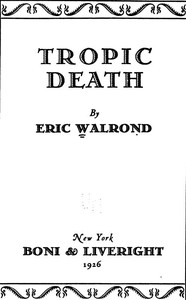
Eric Walrond's 1926 story collection shifts between Barbados and Panama, using dense, sensory prose and dialect to render the physical and psychological pressures on West Indian laborers under colonial and corporate power.
The first story, 'Drought,' opens on a white burning hillside where sun-crazed black stonecutters drop their drills at the eleven o'clock whistle. Walrond immediately establishes a world of bodily extremity: parched throats, chigger-cracked heels, and the 'rhythm of a stride' dissipating into a 'sun-stuffed void.' The prose is thick with sensory detail—the clang of hot drills, the taste of brackish coffee, the feel of adhesive marl—and it moves between a collective peasant chorus and the specific figure of Coggins Rum, a guitar player whose banter with a 'buckra's girl' reveals the racial and sexual hierarchies of a Barbadian village. The story's title is not merely atmospheric; it signals a physical and spiritual aridity that pervades the collection.
Dialect as a Marker of Place and Power
Walrond renders the speech of his West Indian characters in a dense, unapologetic dialect that is neither softened nor translated for the reader. In 'Drought,' a girl calls out, 'Mistah Rum, you gwine play de guitah tee nite, no?' and Coggins replies, 'Come down and dance de fango fo' Coggins Rum and he are play for you.' The grammar and vocabulary—'gwine,' 'tee nite,' 'fango'—are specific to Barbadian creole. Later, in 'The Wharf Rats,' a worker warns Ballet: 'Dah marine is lookin' fo' yo'.' The dialect is not merely decorative; it marks the characters' social position and their distance from the white overseers and marines who speak standard English. The 'buckra' driver in 'Drought' uses a different register, asking 'Didn't you bring me no molasses to pour in the rainwater?'—a colloquial but less creolized English that signals his authority. Walrond uses these linguistic contrasts to underscore the power dynamics of colonial labor.
Violence and the Threat of the Marine
In 'The Wharf Rats,' the narrative shifts to the Panama Canal Zone, where black laborers are driven by armed marines. The story follows Ballet, a water boy who is warned that a marine is looking for him because he 'jook [his] mout' in de ruction yestiddy.' The marine is described as 'a scowling marine' with a pistol and bayonet, and his language is brutally direct: 'Stand up and take yer medicine, yer goddam skunk.' The threat escalates into a chase through the jungle, ending with three gunshots and a terse official report that 'kept the number of casualties in the recent native labor uprising down to one.' Walrond does not moralize; he presents the violence as a routine part of the canal's operation. The marine's hunt for Ballet is both personal and systemic—a punishment for speaking out of turn, but also a demonstration of the racial order that governs the labor camps.
The Body Under Duress: Heat, Hunger, and Flight
Throughout the excerpts, Walrond emphasizes the physical strain on his characters. In 'Drought,' the stonecutters are 'throats parched, grim, sun-crazed,' and hunger 'pricks at stomachs inured to brackish coffee and cassava pone.' The landscape itself is hostile: the 'white burning hillside,' the 'hot creeping marl,' the 'sun-stuffed void.' In 'The Wharf Rats,' Ballet's flight is a series of bodily actions—'He scaled hurdles. He bumped into men'—and his hiding place in a tar barrel is both ludicrous and desperate. The prose captures the sensory overload of the tropics: the heat, the dust, the 'swelling seas growing darker and deadlier.' Yet Walrond also includes moments of song and rhythm, as when the men sing 'pioneer sea songs, pioneer gold songs' while cutting paths through the jungle. These songs are a counterpoint to the violence, a way of asserting humanity under duress.
Structure and the Reader's Orientation
The collection's arrangement—ten stories moving from Barbados to Panama—creates a cumulative portrait of West Indian labor migration. The first story, 'Drought,' is set entirely in a Barbadian village, establishing a world of rural poverty and racial hierarchy. Later stories, such as 'The Wharf Rats' and 'The Black Pin,' shift to the Panama Canal Zone, where the same characters or types encounter the brutal discipline of American imperialism. Walrond does not provide explicit transitions or explanations; the reader must infer the connections from recurring motifs: the guitar, the dialect, the threat of white authority. The title story, 'Tropic Death,' closes the collection, but the excerpts do not reveal its plot. A first-time reader should pay attention to the way Walrond uses sensory detail and dialect to create a dense, immersive world, and to the way violence erupts suddenly, often without narrative warning.
Walrond's prose demands close attention to its rhythms and its silences. The gaps between stories—the unspoken journeys, the unnamed characters who reappear—are as important as the events described. A reader who listens to the dialect, who feels the heat and the dust, and who notes the casual brutality of the marines will find a collection that is both a work of modernist experimentation and a sharp critique of colonial labor. Approach each story as a self-contained episode, but watch for the echoes that bind them together.
Reader reflection
What did you think of this book?
Answer a few questions and save a private reflection on this device.
Your progress
0
/
10
2
How much did you enjoy the reading experience?
3
Would you recommend this book to another reader?
4
How much effort did this book require?
5
Was the book easy to understand?
6
How would you describe its reading pace?
7
Do you expect to return to this book?
8
Would you like to discuss this book with someone?
9
What is the main idea you are taking away?
10