1

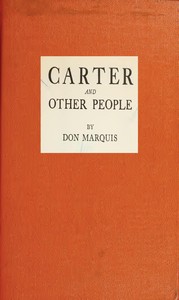
Carter, and Other People — Inside the Classic
6
1
Project Gutenberg
2016
Short stories, American; American fiction -- 20th century
Readers of public-domain and historical texts
Project Gutenberg digital edition
en
Edition facts
Words: 71,764
Reading time: 313 min
Text sections: 8
Source:
Project Gutenberg record #51913
Don Marquis's 1921 collection of thirteen stories and a one-act play, moving between Southern racial tensions, urban anxieties, and moral dilemmas, with recurring motifs of fire, guilt, and internal conflict.
Editorial Edition Score
4.7/5
★★★★★
★★★★★
Calculated from edition completeness, EPUB availability, text structure and catalogue metadata. Not a user rating.
Edition quality
Don Marquis's Carter, and Other People (1921) opens with a story that immediately establishes a pattern of internal division: Carter is described as having seven-eighths Caucasian blood and one-eighth African, a ratio that defines his social identity and fuels a perpetual inner war. The collection moves through varied settings—from Atlanta to New York hotels—and repeatedly returns to characters haunted by their own actions or origins. Fire appears as a charged image: Carter's opening line about carrying his own hell inside, and later an old man who has burned a building for insurance money and now fears divine punishment. The stories, originally published in magazines including Harper's Monthly and The Saturday Evening Post, share a preoccupation with guilt, self-deception, and the struggle to escape one's own history.
Divided Selves and Social Labels
The title story introduces Carter as a man defined by a single drop of African blood, which the narrative calls his “eighth” and which “classified him.” The white part despises the black; the black part hates the white. This internal split is not merely psychological but social: Carter learns he is a “nigger” early in life, and the story traces how that label shapes his existence. Marquis does not present a simple victim narrative; instead, he dramatizes the self-loathing and rage that arise from such categorization. The phrasing “carried his own hell along inside of him” recurs as a motif, linking Carter's torment to a broader pattern in the collection. Other characters, like the old man in later excerpts, also carry internal debates—over sin, forgiveness, and the nature of their own actions. The structure of the book, moving from Carter's overt racial conflict to more hidden forms of guilt, suggests a continuum of divided selves.
Fire as a Recurring Image
Fire appears in multiple stories as both literal event and metaphor. In the excerpt from a later story, an old man is terrified by fire engines, and the night clerk dismisses him as a “rube” nervous about city fires. But the reader learns that the old man has burned his own store and living quarters for insurance money, and now fears that lying to God in prayer constitutes blasphemy against the Holy Ghost. The fire he set becomes an inescapable memory: he reads Matthew 12:31, fixating on the first clause about forgiveness while avoiding the reservation. The image of fire recurs in Carter's “hell inside him,” linking the two stories. Marquis uses fire to externalize internal torment—the old man's fear of fire is really fear of his own past. The collection's movement between scenes, from Atlanta to hotel rooms, often pivots on this image, suggesting that guilt, like fire, can be hidden but not extinguished.
Urban Spaces and Isolation
The stories frequently place characters in anonymous urban settings—hotels, lobbies, city streets—where they are observed by clerks and strangers. The old man in the excerpt is repeatedly appraised by hotel staff as a “rube” or “old duck,” his inner turmoil invisible to them. He retreats to his room, reads his Bible, and debates with himself; the city offers no comfort. Marquis emphasizes the gap between external appearance and internal reality: the clerk sees a nervous old man, but the reader knows his guilt. This technique recurs across the collection: characters are often misread by others, and the narrative grants the reader access to their private agonies. The one-act play “Words and Thoughts,” included at the end, explicitly thematizes the disconnection between speech and inner life. The urban setting amplifies isolation—Carter's hell is internal, but the city provides no community to alleviate it.
The Play Within the Collection
The final item in the book is a one-act play, “Words and Thoughts,” written in 1911 and previously rejected by theatrical managers. Marquis notes in the foreword that he still believes it could be acted with effect. Its inclusion shifts the collection's form: after thirteen short stories, the play offers a different mode of dialogue and conflict. The foreword also reveals that one story, “The Penitent,” was constructed by combining plots from poems by Browning and Owen Meredith, transposed into a modern American setting. Marquis calls it his “only essay in conscious plagiarism” and claims it was harder to invent than to plagiarize. These meta-textual comments give the reader insight into Marquis's craft: he is willing to experiment with form and acknowledge his sources. The play, like the stories, likely deals with the gap between words and inner truth, a theme that runs through the entire collection.
Readers approaching Carter, and Other People will find a collection that rewards attention to recurring images—fire, internal debate, urban isolation—and to the ways characters are defined by forces they cannot control. The stories vary in tone and setting, but the underlying preoccupation with guilt and self-knowledge gives the book a cohesive emotional arc. The inclusion of a one-act play and the author's candid foreword add layers of self-reflection. This is not a collection of light entertainments; it is a series of portraits of people trapped by their own histories, rendered with precision and a dark, unsentimental eye.
Reader reflection
What did you think of this book?
Answer a few questions and save a private reflection on this device.
Your progress
0
/
10
2
How did the book work for you overall?
3
Is this a title you would suggest to others?
4
How much effort did this book require?
5
Did this book create an emotional response?
6
How closely did the book connect with your experience?
7
How valuable was this book for your own interests?
8
Was the book easy to understand?
9
Which lesson or insight stayed with you?
10
![Cover of Seven Men [Excerpts] — Background and Themes](https://eqopi.com/storage/media/covers/pg1306.jpg)

![Cover of Back to back [Night watches, Part 1.] — Key Ideas to Explore](https://eqopi.com/storage/media/covers/pg12151.jpg)
![Cover of The unknown [Night watches, Part 7.] — Story, Setting & Ideas](https://eqopi.com/storage/media/covers/pg12157.jpg)