1

The wounded — Reading Companion
9
0
Project Gutenberg
2024
Short stories; Fantasy fiction
Readers of public-domain and historical texts
Project Gutenberg digital edition
en
Edition facts
Words: 5,082
Reading time: 23 min
Text sections: 1
Source:
Project Gutenberg record #74219
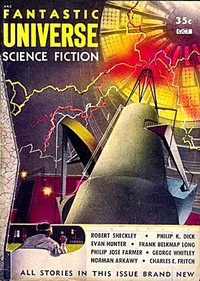
In 'The Wounded,' Philip José Farmer uses a first-person narrator who can see emotional wounds as visible, festering sores. The story begins with 3-D glasses revealing his true nature, blending science fiction with sharp social observation.
Editorial Edition Score
4.3/5
★★★★★
★★★★★
Calculated from edition completeness, EPUB availability, text structure and catalogue metadata. Not a user rating.
Edition quality
Philip José Farmer's 'The Wounded' opens with a narrator whose visibility depends on polarized 3-D glasses—a conceit that immediately establishes the story's blend of science fiction and social satire. The first-person voice is breezy and self-assured, describing himself as the 'biggest gate-crasher in the world,' yet the tone quickly darkens as he observes the 'wounded' around him: people whose emotional pain manifests as visible, festering sores. The narrative pace shifts between rapid, almost cinematic action—a taxi chase, a penthouse party—and moments of still, clinical observation, as when the narrator notes 'the flash of green deep within my hostess' eyes' as 'the green of a long-festering wound.'
A First-Person Voice That Shifts Between Bravado and Detachment
The narrator's voice is the story's engine. He opens with a casual, almost flippant tone: 'Those polaroid glasses they give you at the 3-D movies were the cause of my downfall.' This breeziness persists through the taxi chase and his encounter with the house detective, where he deflects suspicion with a quip about being a 'child prodigy.' Yet the same narrator also delivers detached, almost clinical observations: the detective is 'one of the wounded, always eating to stuff the ache and the hollowness of it.' This oscillation between self-assured banter and cold analysis creates an unsettling rhythm. The narrator never explains his own nature directly, leaving the reader to infer from his actions and the reactions of others. The voice itself becomes a clue, hinting at a being who is both inside and outside human experience.
Visible Wounds as a Narrative Device
Farmer literalizes emotional damage: the 'wounded' carry visible, colored sores—green, swelling—that the narrator can see. This device allows him to compress characterization into a single image. The house detective's 'ache' is made tangible; the hostess's jealousy is 'the flash of green deep within' her eyes. The narrator himself seems immune, observing without sympathy. The wounds are not described in detail but are evoked through color and texture: 'the green of a long-festering wound,' 'the swelling of the injured spot.' This sparing use of description keeps the focus on the narrator's perception rather than the wounds themselves. The device also creates a moral landscape: the wounded are not merely sad but are marked by their pain, and the narrator moves among them as a kind of predator or parasite.
Pacing Through Action and Stillness
The story's pacing is controlled by alternating bursts of action with moments of static observation. The opening sequence—the movie theater, the taxi chase—moves quickly, with short sentences and rapid scene changes: 'I thought, I'd have to tell Mother about this. Then I walked out fast.' But once inside the penthouse, the pace slows. The narrator stands still, watching the hostess and her husband, describing the light and the wounds in deliberate detail. This contrast mirrors the narrator's dual nature: he can move through the world with speed and ease, but he also pauses to study his prey. The house detective's sandwich-eating is a small, slow action that underscores the narrator's patience. The excerpt ends mid-scene, leaving the reader suspended between action and revelation.
Readers should attend to what the narrator does not say. His silences—about his own origins, his mother, the nature of his 'wounding' of others—are as telling as his observations. The story's science-fictional premise is delivered through a mundane object (3-D glasses) and a mundane setting (a party), grounding the fantastic in the everyday. Farmer's prose rewards attention to small details: a sandwich, a violin case, a shift in light. These are not decorations but clues to the narrator's method and the story's moral logic.
Reader reflection
Your personal reading reflection
Build a private reading journal entry for this title.
Your progress
0
/
10
2
How did the book work for you overall?
3
How likely are you to recommend this book?
4
What was the reading difficulty like?
5
How much did the book move you?
6
How clearly were the main ideas presented?
7
Would this book work well in a reading group?
8
Did the story or argument move comfortably?
9
What is the main idea you are taking away?
10
![Cover of Seven Men [Excerpts] — Background and Themes](https://eqopi.com/storage/media/covers/pg1306.jpg)

![Cover of Back to back [Night watches, Part 1.] — Key Ideas to Explore](https://eqopi.com/storage/media/covers/pg12151.jpg)
![Cover of The unknown [Night watches, Part 7.] — Story, Setting & Ideas](https://eqopi.com/storage/media/covers/pg12157.jpg)