1

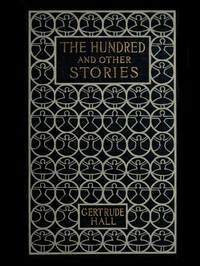
The Hundred, and Other Stories — Reading Notes
8
1
Project Gutenberg
2019
Short stories, American; American fiction -- 19th century
Readers of public-domain and historical texts
Project Gutenberg digital edition
en
Edition facts
Words: 49,454
Reading time: 216 min
Text sections: 8
Source:
Project Gutenberg record #60469
Gertrude Hall's 1890s stories pair ornate domestic details with supernatural undercurrents, as in 'The Hundred' where a maid's Christmas Eve unravels, and 'The Countess Paula' where a pianist senses a ghostly visitor. The prose shifts from satirical social observation to quiet, eerie longing.
The opening of 'The Hundred' immediately establishes a tension between domestic routine and suppressed emotion. Mrs. Darling scolds her maid Bonnet over a knotted corset-lace, yet the chamber is described with delicate luxury: 'gas-globes at the ends of their jointed gold arms looked like splendid yellow pearls.' The narrative voice lingers on material details—embossed silverware, a black moiré dress—while the dialogue reveals a brittle mistress who alternates between acid complaints and sudden, almost theatrical generosity. This juxtaposition of opulent setting and frayed nerves sets a pattern for the collection: the surface of genteel life is repeatedly disturbed by undercurrents of longing, resentment, or the uncanny.
A Voice That Shifts Between Satire and Sympathy
The excerpts show Hall moving fluidly from sharp social observation to interior pathos. In 'The Hundred,' the narrator notes that 'every heart in her little establishment rejoiced' at Mrs. Darling's absence—a dry, collective perspective that exposes the household's relief. Yet when Bonnet fumbles with the tongs, the prose tightens to convey her nervous precision: 'with infinite solicitude took hold again of the golden strand.' The same story later shifts to Bonnet's own Christmas Eve plans, suggesting a world of private desires beneath servitude. In 'The Countess Paula,' the tone becomes more lyrical and ambiguous. The pianist Prospero, after a night out, 'let his fancies and emotions make themselves sound'—a phrase that blurs conscious composition with involuntary expression. Hall's willingness to inhabit both the satirical and the tender gives the collection a restless, unpredictable texture.
Objects as Emotional Markers
Hall repeatedly uses physical objects to anchor psychological states. In 'The Hundred,' the dressing-table is crowded with 'highly embossed silverware, out of all reasonable proportion with the little person owning it'—a detail that hints at vanity or insecurity. The photograph of a 'still young, well-looking man' leaning against the clock introduces a silent, unexplained presence. In 'The Countess Paula,' the piano and scattered music sheets form 'the chief adornment' of Prospero's bare room, emphasizing his absorption in sound over material comfort. The Countess herself is transformed by her unbound hair, which 'shining along her cheeks like a pale gilded mist' becomes almost a supernatural attribute. These objects are not mere decoration; they carry the weight of unspoken histories and desires.
The Unseen and the Unspoken
Both excerpts rely on what is withheld. In 'The Hundred,' the story's title—and the maid's name, Bonnet—may allude to something beyond the domestic comedy, but the excerpt does not reveal it. The narrative leaves the photograph's significance ambiguous. In 'The Countess Paula,' the supernatural element is introduced through sensory gaps: Prospero feels 'a cool air on his forehead' before seeing the Countess, and his voice 'failed to answer his will.' The Countess's entrance is silent, her purpose unclear. She 'looked all about the room, very slowly, as a person seeking something' but does not speak. Hall builds tension through what is not said or shown, trusting the reader to inhabit the characters' uncertainty. This technique recurs across the collection, rewarding attention to pauses and omissions.
Structure and the Fragmentary Whole
The collection's title, The Hundred, and Other Stories, suggests a central piece surrounded by shorter works. The excerpts offer only two stories, leaving the overall arrangement unknown. However, the contrast between the two is instructive: 'The Hundred' is grounded in a specific Christmas Eve household, while 'The Countess Paula' moves into a more ethereal, almost Gothic register. Hall's prose style remains consistent—attentive to sensory detail, rhythm, and shifting focalization—but the subject matter ranges from social satire to ghostly encounter. Readers approaching the full collection should expect tonal variety and a willingness to leave narrative threads unresolved. The stories may reward rereading, as early details (a photograph, a knotted lace) can acquire new significance in light of later revelations.
Hall's stories often hinge on a single, charged moment—a scolding, a silent visitation—rather than elaborate plots. Pay attention to the spaces between dialogue, the objects that catch the narrator's eye, and the characters who hover at the edges of scenes. The collection rewards patience with its quiet, oblique approach to desire and disappointment.
Reader reflection
How will you remember this book?
Save your reaction, strongest insight, and memorable passage.
Your progress
0
/
10
2
What was your overall reaction to the book?
3
Is this a title you would suggest to others?
4
Did the language feel accessible?
5
Was the book what you thought it would be?
6
Would this book work well in a reading group?
7
Which aspect of the book did you value most?
8
Was the book moving at the right speed?
9
In one sentence, what did you learn?
10
![Cover of Seven Men [Excerpts] — Background and Themes](https://eqopi.com/storage/media/covers/pg1306.jpg)

![Cover of Back to back [Night watches, Part 1.] — Key Ideas to Explore](https://eqopi.com/storage/media/covers/pg12151.jpg)
![Cover of The unknown [Night watches, Part 7.] — Story, Setting & Ideas](https://eqopi.com/storage/media/covers/pg12157.jpg)