1

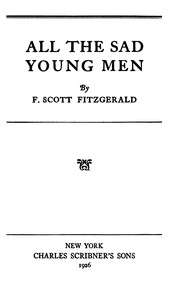
All the Sad Young Men — Context and Discussion
8
0
Project Gutenberg
2022
Short stories, American; American fiction -- 20th century
Readers of public-domain and historical texts
Project Gutenberg digital edition
en
Edition facts
Words: 67,797
Reading time: 295 min
Text sections: 6
Source:
Project Gutenberg record #68229
Fitzgerald's 1926 collection explores wealth, class, and emotional fragility through nine stories, including 'The Rich Boy' and 'Winter Dreams.' The opening essay on the rich as 'different' sets a skeptical tone, while tales like 'Rags Martin-Jones' blend satire with pathos. A precise, unsentimental look at the Jazz Age's sad young men.
Editorial Edition Score
4.7/5
★★★★★
★★★★★
Calculated from edition completeness, EPUB availability, text structure and catalogue metadata. Not a user rating.
Edition quality
Fitzgerald opens 'The Rich Boy' with a provocative claim: the rich 'are different from you and me.' This collection of nine stories, published in 1926, tests that assertion repeatedly, often finding the difference to be a kind of emotional softness or cynicism born of early possession. The narrator of 'The Rich Boy' warns that to accept the rich boy's point of view is to be left with 'a preposterous movie,' and the stories that follow—from 'Winter Dreams' to 'Rags Martin-Jones'—play out variations on that warning.
The excerpts show Fitzgerald experimenting with narrative frames, shifting between first-person commentary and third-person scenes. The opening essay on types versus individuals, and the claim that 'there are no plurals,' establishes a tension between the general and the particular that runs through the volume.
The Rich as Foreigners
In 'The Rich Boy,' the narrator insists on approaching Anson Hunter 'as if he were a foreigner.' This strategy of deliberate estrangement recurs across the collection. The rich are depicted as speaking a different language—the Hunter boys acquire 'an accent that is peculiar to fashionable people in the city of New York'—and as inhabiting a separate moral universe. Fitzgerald's prose mirrors this distance: he describes the rich with a cool, analytical precision that refuses to romanticize. The narrator's claim that the rich 'think, deep in their hearts, that they are better than we are' is not presented as envy but as a structural observation about class psychology.
Satire and the Exaggerated Gesture
'Rags Martin-Jones' pushes toward farce. The heiress's entrance is a cascade of hyperbole: the pier 'sway and bend from the shock of her beauty,' a shark dives 'broken-hearted' back into the sea. The story's tone is deliberately over-the-top, with a monocle that 'persistently fell out' and a suitor who is literally pushed off a dock. Yet the satire has an edge. Rags's wealth—seventy-five million inherited after her parents went down on the Titanic—is presented as a kind of absurdist tragedy. The laughter and yawning suggest a boredom that borders on nihilism. Fitzgerald uses comic exaggeration to probe the emptiness beneath the glitter.
Voice and Narrative Framing
The collection's first story establishes a distinctive narrative voice: intimate yet detached, confessional yet analytical. The narrator of 'The Rich Boy' admits to having 'lived among his brothers' and calls the rich boy 'my friend,' but maintains a stubborn point of view. This framing recurs in other stories, where Fitzgerald often inserts a narrator who comments on the action. The effect is to create a sense of distance even in moments of high emotion. The stories are not told from inside the characters' heads but observed from a slight remove, as if the narrator is trying to understand a species. This technique reinforces the theme of the rich as unknowable, even to those who know them well.
Readers approaching this collection should pay attention to the shifts in tone between stories. 'The Rich Boy' and 'Winter Dreams' offer a more somber, psychological realism, while 'Rags Martin-Jones' and 'The Baby Party' lean into satire. Fitzgerald's control of voice—sometimes wry, sometimes elegiac—is the unifying element. The stories reward close attention to how he handles point of view, especially the moments when the narrator steps back to generalize about wealth, class, or human nature.
Reader reflection
How will you remember this book?
Save your reaction, strongest insight, and memorable passage.
Your progress
0
/
10
2
Was reading this book enjoyable?
3
How likely are you to recommend this book?
4
Did the language feel accessible?
5
Could you follow the author’s main argument?
6
Did it raise ideas you would like to talk about?
7
How would you rate its originality?
8
How did the reading compare with what you expected?
9
What changed or sharpened your thinking?
10
![Cover of Stepping backwards [Night watches, Part 5.] — Context and Discussion](https://eqopi.com/storage/media/covers/pg12155.jpg)
![Cover of The vigil [Night watches, Part 8.] — Key Ideas to Explore](https://eqopi.com/storage/media/covers/pg12158.jpg)