1

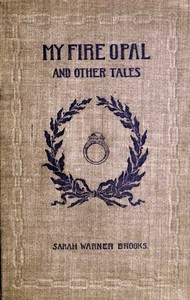
My Fire Opal, and Other Tales — Inside the Classic
16
3
Project Gutenberg
2012
Short stories; Prisoners -- Fiction; Prisons -- Fiction
Readers of public-domain and historical texts
Project Gutenberg digital edition
en
Edition facts
Words: 46,001
Reading time: 201 min
Text sections: 5
Source:
Project Gutenberg record #39815
Brooks's 1896 collection uses a conversational frame narrator and shifting focalization to explore prison life. The title story opens with a wife's comic defiance, while later tales adopt a third-person view of convicts and a warden's child. Observations on voice, pacing, and descriptive detail emerge from the excerpts.
Editorial Edition Score
4.7/5
★★★★★
★★★★★
Calculated from edition completeness, EPUB availability, text structure and catalogue metadata. Not a user rating.
Edition quality
The title story of Sarah Warner Brooks's 1896 collection begins not behind bars but at a breakfast table, where the narrator, Isabel, playfully dismisses her husband Alcibiades's concern about leaving her alone. The opening dialogue—with its mock curtsies and literary allusions—establishes a brisk, ironic voice that contrasts sharply with the prison settings to come. Brooks signals her dual interest in domestic comedy and social inquiry from the first page.
The preface states that these tales are “woven, almost equally, of fact and fiction,” based on “intimate personal observation ‘behind the bars.’” This blend of reportorial detail and narrative artifice shapes the collection’s shifting tone, from the narrator’s arch asides to the sympathetic rendering of convicts and prison staff.
A Narrator Who Refuses to Be Solemn
The opening of “My Fire Opal” establishes a voice that is self-aware, witty, and resistant to melodrama. Isabel addresses her husband with a “derisive courtesy” and caps her argument by quoting Byron. The pace is quick, the paragraphs short, and the tone conversational—Brooks even inserts a stage direction (“in the wind of his going”). This lightness is deliberate: it sets up a contrast with the grim material that follows, and it also establishes the narrator as a skeptical observer, not a sentimentalist.
Later, when Cicely departs, Isabel declares herself “Monarch of all I survey,” a comic echo of Alexander Selkirk. The humor is not merely decorative; it signals Brooks’s method of using literary reference to frame ordinary experience. The narrator’s voice remains present throughout the collection, but it modulates—sometimes ironic, sometimes earnest—depending on the tale.
Shifts in Focalization and Descriptive Pace
In “A Prison Child,” the narrative moves away from the first-person frame and adopts a third-person view centered on Mabel, the warden’s daughter. The prose slows and becomes more sensory: the child “pattered right and left, on tiny aimless feet,” and the prison is rendered through her gaze—the “dizzy flights of iron stairs,” the “shifting panorama of human faces.” Brooks uses longer, more rhythmic sentences to evoke the child’s unhurried perception.
This shift in pace is accompanied by a change in descriptive density. Where the opening story favored brisk dialogue, here Brooks lingers on details: the “golden-haired toddler,” the “white baby gown,” the “pungent checkerberry lozenges.” The effect is to make the prison environment strange and poignant through the child’s eyes, without moralizing.
Recurring Motifs and Structural Echoes
Across the excerpts, certain motifs recur: confinement and freedom, observation and sympathy. The title story’s domestic imprisonment (a woman alone in a house) mirrors the literal imprisonment of later tales. The narrator’s joke about burglars finds a serious echo in the prison’s locked doors and iron gratings.
Brooks also repeats the device of a sympathetic observer. In “My Fire Opal,” Isabel watches the world from her home; in “A Prison Child,” the narrative watches through Mabel’s eyes. The turnkey Timothy Tucker, who keeps birds in the guard-room, embodies this observational stance: he is a “dragon at holding a door” yet tender to “little birds and little children.” These structural echoes suggest that Brooks is less interested in plot than in the moral act of looking—and the responsibility that comes with it.
Brooks’s collection rewards attention to its narrative architecture: the way a comic first-person voice gives way to a more measured third-person sympathy, and the way descriptive pace slows to match a child’s wonder. Readers may find that the stories gain resonance when read in sequence, as the shifts in tone and focalization create a cumulative portrait of prison life that is neither sensational nor sentimental, but quietly observant.
Reader reflection
What was your reading experience?
Capture what you thought, learned, and would like to remember.
Your progress
0
/
10
2
Did this book hold your interest?
3
Would you recommend this book to another reader?
4
What was the reading difficulty like?
5
How clearly were the main ideas presented?
6
Which aspect of the book did you value most?
7
Did the book meet your expectations?
8
How closely did the book connect with your experience?
9
What changed or sharpened your thinking?
10


![Cover of Stepping backwards [Night watches, Part 5.] — Context and Discussion](https://eqopi.com/storage/media/covers/pg12155.jpg)
![Cover of The vigil [Night watches, Part 8.] — Key Ideas to Explore](https://eqopi.com/storage/media/covers/pg12158.jpg)