1

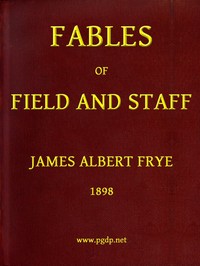
Fables of Field and Staff — Story, Setting & Ideas
8
2
Project Gutenberg
2015
Short stories, American; Soldiers -- Fiction
Readers of public-domain and historical texts
Project Gutenberg digital edition
en
Edition facts
Words: 41,148
Reading time: 179 min
Text sections: 11
Source:
Project Gutenberg record #48545
Seven linked stories about a volunteer infantry regiment in peacetime, narrated by an officer who recounts misadventures involving a horse named Acme, a medal-winning veteran, and a chaotic train escape, all told with dry humor and military insider detail.
Editorial Edition Score
4.7/5
★★★★★
★★★★★
Calculated from edition completeness, EPUB availability, text structure and catalogue metadata. Not a user rating.
Edition quality
The narrator of Fables of Field and Staff introduces himself as a member of “The Third,” a volunteer infantry regiment, and addresses readers directly as potential comrades or outsiders. The preface establishes a tone of wry camaraderie: those who have served will “catch the spirit,” while civilians must “take your chance.” The seven fables, the narrator claims, are “seasoned abundantly … with that which is stranger than fiction,” yet he insists they are not official muster rolls. This framing sets up a collection that blends tall-tale exaggeration with the mundane routines of garrison life, as seen in the excerpt from “The March of the Forty Thieves,” where a dinner bill prompts a protagonist to flee via a moving train, aided by a policeman’s accidental tackle.
Volunteer Service as a Lens
The catalog subjects label Fables of Field and Staff as “Soldiers — Fiction,” but the excerpts reveal a specific focus: the volunteer service, not the regular army. The preface distinguishes between “The Army” and the volunteer service, calling the latter “distantly related.” This distinction shapes the humor and setting. In “The March of the Forty Thieves,” the narrator’s escape hinges on knowing local train schedules and the habits of a small-town policeman—details that assume familiarity with peacetime garrison life rather than combat. The stories are not about battle but about off-duty escapades, regimental traditions, and the easygoing ways of a volunteer unit. The narrator’s tone is that of an insider sharing anecdotes with fellow veterans, not a historian recording official events.
Narrative Voice and Structure
The excerpts show a first-person narrator who is both participant and raconteur, addressing the reader as “you” and assuming shared knowledge. In “The March of the Forty Thieves,” he describes his plan in detail: “I’d recalled the fact … that the down mail-train from Canada was due to strike the town at two-forty-eight.” The voice is colloquial and self-deprecating, as when he admits he “had to hop like a monkey” to board the train. The stories are framed as “fables,” but the preface warns they “differ slightly from ‘muster-rolls for pay,’” implying a playful relationship with truth. The inventory lists seven titles, each a self-contained episode, yet the narrator refers to an earlier book about the same regiment, suggesting a continuing chronicle. The structure is episodic, held together by the recurring setting of “The Battery” and the cast of officers.
Recurring Details and Their Limits
From the excerpts, several details recur: the long room called The Battery, a horse named Acme, a veteran gunner named Sam who won a medal, and a seventh major named Larry who “rose to the rank of hero.” These are mentioned in the preface as part of an earlier book, indicating that Fables of Field and Staff builds on established lore. However, the excerpts do not reveal how these elements function in the current stories. The catalog subject “Short stories, American” is accurate, but the tone is more anecdotal than literary. The narrator’s voice is consistent across the preface and the story excerpt, suggesting a unified persona. Without the full text, it is unclear whether the fables have moral conclusions or remain pure entertainments. The excerpts show a preference for comic set-pieces over character development.
Readers should approach Fables of Field and Staff as a series of linked yarns rather than a novel. The narrator’s direct address and insider jargon reward patience with military slang, but the humor is accessible. Pay attention to the tension between the “strange and wonderful” claims and the mundane settings—this contrast drives the comedy. The excerpts offer only a sample of the regiment’s lore; the full collection likely expands on the characters mentioned in passing.
Reader reflection
Before you leave, reflect on the book
Use these questions to collect your thoughts before moving on.
Your progress
0
/
10
2
How much did you enjoy the reading experience?
3
How likely are you to recommend this book?
4
Did the language feel accessible?
5
Could you follow the author’s main argument?
6
Did the book deliver what you hoped for?
7
Did anything about the book feel genuinely new?
8
Could you apply anything you learned?
9
What did this book teach you most?
10



![Cover of Stepping backwards [Night watches, Part 5.] — Context and Discussion](https://eqopi.com/storage/media/covers/pg12155.jpg)
![Cover of The vigil [Night watches, Part 8.] — Key Ideas to Explore](https://eqopi.com/storage/media/covers/pg12158.jpg)