1

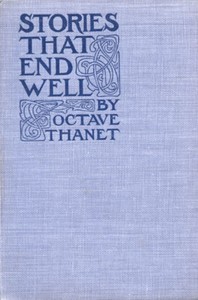
Stories That End Well — Key Ideas to Explore
8
1
Project Gutenberg
2010
Fiction; Short stories
Readers of public-domain and historical texts
Project Gutenberg digital edition
en
Edition facts
Words: 73,182
Reading time: 319 min
Text sections: 7
Source:
Project Gutenberg record #33499
Octave Thanet's 1911 collection of twelve stories, including 'An Adventure in Altruria' and 'The Stout Miss Hopkins' Bicycle,' uses a framing narrator and sharp dialogue to explore social contrasts, personal transformation, and the tension between idealism and practicality in early 20th-century America.
Editorial Edition Score
4.7/5
★★★★★
★★★★★
Calculated from edition completeness, EPUB availability, text structure and catalogue metadata. Not a user rating.
Edition quality
Octave Thanet's Stories That End Well (1911) opens with a framing device: the narrator, a friend of the cook Mrs. Katherine Biff, relays her "adventure in Altruria" while working for a socialist heiress. This layered narration—a literate observer filtering a shrewd cook's account—establishes a pattern of indirect perspective. Throughout the collection, Thanet favors dialogue and concrete detail over authorial commentary, letting characters reveal themselves through speech and action. The title itself promises resolution, but the stories earn their endings through careful setup, often hinging on a single object or encounter that shifts a character's trajectory.
Nested Voices and Social Observation
The collection's first story, "An Adventure in Altruria," introduces a narrative structure Thanet returns to: a story within a story, told by a working-class woman to a middle-class listener. Mrs. Biff, a widow who "out of her savings has helped educate and settle half a dozen of her nieces and nephews," speaks in a distinctive voice—practical, wry, and skeptical of abstract ideals. Her employer, Miss Van Arden, is described as "a stray angel in a wicked world and thinks she is a socialist." This contrast between lived experience and ideological naivete recurs across the volume. In "The Stout Miss Hopkins' Bicycle," a bicycle becomes the catalyst for a woman's physical and social transformation, while the narrator's friend Mrs. Ellis observes with a "sporting tinge of thought." Thanet's characters often serve as commentators on one another, creating a layered social portrait without authorial intrusion.
Objects as Turning Points
Several stories hinge on a tangible object that precipitates change. In "The Stout Miss Hopkins' Bicycle," the bicycle itself is the agent: Miss Hopkins, who "had suffered from her figure," is mistaken for her slender niece after taking up cycling, leading to a romantic misidentification that ultimately resolves in her favor. The narrator notes that the bicycle "didn't need to do anything" for the man's admiration—yet the object enables the encounter. Similarly, in "The Spellbinder," a letter from a "luxurious young scoundrel" demanding "a fire in his room, and plenty of hot water and towels" sets the stage for a confrontation between a community and an outsider. The driver's bitter comment—"you don't catch buzzards staying in for weather"—reveals class resentment through a single metaphor. These objects are not symbols but practical catalysts, grounding the stories in material reality.
Dialogue-Driven Conflict and Regional Voice
Thanet renders conflict primarily through dialogue, often in regional or class-inflected speech. In "The Spellbinder," two men in a wagon debate the treatment of an incoming stranger: the driver's sullen hostility contrasts with his companion's more cautious, genial tone. The driver dismisses the local hotelkeeper as "a coward from Wayback," while the other man, "rubbing his hands up and down his wrists under his frayed sleeves," asks if they mean only to "scare the lad well." The exchange is economical, conveying backstory—a previous man was "fairly paralyzed" by tales of violence—and moral ambiguity without exposition. In "An Adventure in Altruria," Mrs. Biff's voice carries the story: her comment on funerals—"When I give free rides, I'll give 'em while I'm alive and can hear folks say 'Thank you!'"—encapsulates her worldview in a single sentence. Thanet trusts her characters' words to carry the weight of theme.
Readers approaching Stories That End Well will find a collection that rewards attention to narrative frame and spoken idiom. Thanet's stories are not plotted around dramatic reversals but around small, credible shifts in circumstance or perception. The endings, while positive, feel earned through the accumulation of detail rather than contrivance. For those interested in early twentieth-century American fiction that balances social commentary with character-driven storytelling, this volume offers a compact, varied sample of Thanet's craft.
Reader reflection
Record your reading impressions
A brief reflection can help important ideas stay with you longer.
Your progress
0
/
10
2
Did this book hold your interest?
3
How likely are you to recommend this book?
4
How easy was the book to follow?
5
Was the book what you thought it would be?
6
What was the strongest part of the book?
7
Did anything about the book feel genuinely new?
8
Is this a title worth rereading?
9
What changed or sharpened your thinking?
10



![Cover of Stepping backwards [Night watches, Part 5.] — Context and Discussion](https://eqopi.com/storage/media/covers/pg12155.jpg)
![Cover of The vigil [Night watches, Part 8.] — Key Ideas to Explore](https://eqopi.com/storage/media/covers/pg12158.jpg)