1

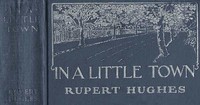
In a Little Town — Story, Setting & Ideas
10
1
Project Gutenberg
2009
Short stories; Middle West -- Fiction
Readers of public-domain and historical texts
Project Gutenberg digital edition
en
Edition facts
Words: 96,402
Reading time: 420 min
Text sections: 9
Source:
Project Gutenberg record #29561
Rupert Hughes's 1917 collection of short stories set in the Middle West, focusing on small-town life with a foreword that rejects idealized or demonized portrayals. The excerpt from 'Don't You Care!' follows Will Rudd, a shoe clerk, and his wife Martha through their ambitious dreams for a child and a devastating stillbirth.
Editorial Edition Score
4.8/5
★★★★★
★★★★★
Calculated from edition completeness, EPUB availability, text structure and catalogue metadata. Not a user rating.
Edition quality
Rupert Hughes opens his 1917 collection In a Little Town with a foreword that directly challenges literary clichés about small towns. He dismisses the notion that villages are Arcadias or cities are Babylons, insisting that 'a city is only a lot of small towns put together.' This framing sets the stage for stories that aim to be 'true to truth' rather than sentimental or sensational. The excerpt from the first story, 'Don't You Care!,' introduces Will Rudd, a shoe clerk whose patient, unambitious nature contrasts with his wife Martha's restless drive. Their shared dreams for an unborn child—debated with names like Eric or Gwendolynne—collapse when the child is stillborn and Martha dies. Hughes renders the aftermath in stark, physical details: the 'shabby pageant' of the funeral, the 'first shovelful of clods rattling on a coffin.'
Catalog Subjects vs. Actual Content
The catalog lists this work under 'Science Fiction & Utopias,' yet the foreword explicitly rejects utopian framing. Hughes writes that small towns are not 'Arcadias or Utopias,' and the excerpt from 'Don't You Care!' depicts a grim domestic tragedy—a stillbirth, a wife's death, a husband's numbness. The 'Middle West' subject is accurate: the foreword places the stories 'in the valley of the Mississippi River,' and Rudd's world of shoe sales, carpet slippers, and evening paper serials evokes a specific regional ordinariness. But the science fiction label appears to be a misclassification; nothing in the provided text suggests speculative or futuristic elements. Readers should approach the collection as realistic fiction grounded in early twentieth-century small-town life, not as utopian or science fiction.
Voice and Narrative Distance
Hughes employs a narrator who is sympathetic but detached, often using ironic or understated phrasing. Of Will Rudd, he notes: 'He was for carpet slippers, round-toed shoes, and on wet days, rubbers; on slushy days he even descended to what he called "ar'tics."' The colloquialism 'ar'tics' is rendered in scare quotes, signaling the narrator's amused distance. Similarly, Martha's ambition is described as 'frantically, fantastically ambitious,' with the repetition underlining her excess. The narration shifts between free indirect discourse—'President of the United States, mebbe; or at least the President's wife'—and blunt reportage: 'The doctor told him that the little body of his son had been born still.' This tonal range, from wry observation to stark fact, characterizes the collection's approach to small-town lives.
Recurring Motifs: Shoes, Waiting, and Anticipation
Shoes function as a leitmotif in the excerpt. Will Rudd is a shoe clerk who 'never sold shoes so well' during his wife's pregnancy, and he brings home 'the smallest size made' as a token of the expected child. After the stillbirth, the shoes become a cruel reminder of anticipation unfulfilled. The motif extends to Rudd's own footwear—carpet slippers, rubbers, arctics—which symbolize his contentment with modest comfort. Waiting is another thread: Rudd 'waited with a hope-lit serenity' for the child, then 'waited outside the room, just twiddling his fingers' after the doctor's news. The foreword's phrase 'anticipation is a great thing—it is all that some people get' echoes through the story, where the Rudds' golden period is precisely that: anticipation without fulfillment.
Readers should note that the provided excerpt represents only one of fifteen stories listed in the table of contents. Titles such as 'Pop,' 'Baby Talk,' and 'The Happiest Man in Ioway' suggest a range of tones and situations. The foreword's insistence on truth over stereotype invites attention to how Hughes balances empathy with irony across the collection. Pay particular attention to the narrative voice: it shifts between close observation and wry commentary, often within a single paragraph.
Reader reflection
What did you think of this book?
Answer a few questions and save a private reflection on this device.
Your progress
0
/
10
2
How much did you enjoy the reading experience?
3
Would you pass this book on to a friend?
4
How demanding did the text feel?
5
Did any part of the book feel personally relevant?
6
Was the book moving at the right speed?
7
Which element worked best for you?
8
Is this a title worth rereading?
9
Which lesson or insight stayed with you?
10

![Cover of Stepping backwards [Night watches, Part 5.] — Context and Discussion](https://eqopi.com/storage/media/covers/pg12155.jpg)
![Cover of The vigil [Night watches, Part 8.] — Key Ideas to Explore](https://eqopi.com/storage/media/covers/pg12158.jpg)