1

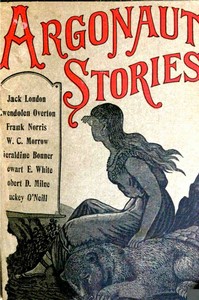
Argonaut stories — Context and Discussion
10
0
Project Gutenberg
2022
Short stories, American; American fiction
Readers of public-domain and historical texts
Project Gutenberg digital edition
en
Edition facts
Words: 79,365
Reading time: 346 min
Text sections: 26
Source:
Project Gutenberg record #68408
This editorial note examines authorial choices in Jerome Hart's 1906 anthology of twenty-six short stories from The Argonaut, focusing on diction, dialogue, and description in excerpts by Jack London, W.O. McGeehan, and others.
Editorial Edition Score
4.8/5
★★★★★
★★★★★
Calculated from edition completeness, EPUB availability, text structure and catalogue metadata. Not a user rating.
Edition quality
Jerome Hart’s 1906 anthology Argonaut Stories collects twenty-six short stories originally published in the San Francisco weekly The Argonaut. The excerpts reveal a deliberate editorial preference for compressed, sensory openings and dialogue that carries narrative weight. Jack London’s “Moon-Face” begins with a precise physical description—the narrator’s visceral hatred for a man whose features are likened to “a dough-ball upon the ceiling”—while W.O. McGeehan’s “Leaves on the River Pasig” opens with a Spanish song that foreshadows tragedy. These choices establish tone and conflict without exposition.
Diction and the Unreliable Narrator
In “Moon-Face,” London’s narrator admits his hatred is “so elusive, so intangible, as to defy clear, definite analysis in words.” The diction here—cumbered, superstitious, offense—creates a tone of obsessive rationalization. The narrator’s self-awareness does not make him reliable; instead, it deepens the unease. Hart’s selection privileges such psychological ambiguity over straightforward villainy. The story’s conflict is internal, not external, and the language mirrors that inward turn.
Dialogue as Dramatic Irony
McGeehan’s “Leaves on the River Pasig” uses dialogue to build tension through what is left unsaid. The Filipino woman Simplicia tells the American soldier, “I do not care for him. On my soul, I do not!”—but her protestation is undercut by her earlier shudder at the river’s leaves. The soldier’s response, “I would not bring you any trouble,” is hollow; his laughter at the situation reveals a “devil in his blood.” The dialogue here does not advance plot so much as it exposes character and foreboding.
Description and Setting as Symbol
Both excerpts use physical description to encode meaning. London’s moon-faced man is a study in symmetry: “cheek-bones wide apart, chin and forehead melting into the cheeks.” The narrator’s hatred is tied to this geometry, as if the face itself is an offense. In McGeehan, the Pasig River is not just a setting but a symbol of drift and loss, echoed in the song’s refrain about leaves “helpless they drift on its swift running surface.” The river’s description—sliminess foul, waters eternal—mirrors the story’s moral murkiness.
Structural Choices in the Anthology
Hart opens the collection with London’s psychological horror and closes with Kathleen Thompson’s “The Colonel and ‘The Lady’,” a story presumably set in the West. The table of contents shows a mix of known authors (Frank Norris, Stewart Edward White) and lesser-known ones (Buckey O’Neill, Neil Gillespie). This arrangement suggests an editorial aim to showcase variety in voice and setting—from the Philippines to San Francisco to the frontier—while maintaining a consistent interest in compressed, character-driven narratives.
Readers approaching Argonaut Stories should attend to how each story establishes its world in the first paragraph. Hart’s authors rarely waste words on setting; instead, they embed conflict in a single image or line of dialogue. The anthology rewards attention to these small authorial choices—the turn of phrase, the withheld detail—that together define a distinctive early twentieth-century short story aesthetic.
Reader reflection
Your personal reading reflection
Build a private reading journal entry for this title.
Your progress
0
/
10
2
How much did you enjoy the reading experience?
3
Is this a title you would suggest to others?
4
How demanding did the text feel?
5
How much did the book move you?
6
Which aspect of the book did you value most?
7
Did the book meet your expectations?
8
Did the book give you something worth debating?
9
What is the main idea you are taking away?
10


![Cover of Stepping backwards [Night watches, Part 5.] — Context and Discussion](https://eqopi.com/storage/media/covers/pg12155.jpg)
![Cover of The vigil [Night watches, Part 8.] — Key Ideas to Explore](https://eqopi.com/storage/media/covers/pg12158.jpg)