1

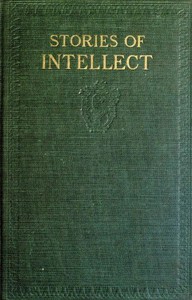
Stories of Intellect — Themes and Context
11
1
Project Gutenberg
2020
Fiction; Short stories
Readers of public-domain and historical texts
Project Gutenberg digital edition
en
Edition facts
Words: 59,933
Reading time: 261 min
Text sections: 7
Source:
Project Gutenberg record #61668
Seven stories by authors including Poe, Dickens, and Hawthorne, selected for their focus on intellectual puzzles, psychological suspense, and supernatural phenomena. The collection highlights narrative voice and pacing shifts, from De Quincey's satirical essay to Lytton's haunted house tale.
Editorial Edition Score
4.7/5
★★★★★
★★★★★
Calculated from edition completeness, EPUB availability, text structure and catalogue metadata. Not a user rating.
Edition quality
The seven works gathered in Stories of Intellect share a preoccupation with the mind under duress—whether confronted by a haunted room, a doppelgänger, or a murder aestheticized as art. The editor, Rossiter Johnson, has chosen pieces that foreground ratiocination and psychological unraveling rather than action. Poe’s “The Fall of the House of Usher,” for instance, builds dread through the narrator’s careful observation of Usher’s “cadaverously wan” countenance and the “faintly luminous” exhalation around the mansion. In Lytton’s “The House and the Brain,” the terror is explicitly “undefinable,” located in an empty room that drives away every lodger. These stories reward a reader attentive to narrative voice and the deliberate manipulation of pace.
Narrative Framing and Unreliable Testimony
Several stories employ a framing device that distances the reader from direct experience. Lytton’s tale opens with a friend recounting a haunted house secondhand, insisting he will not be “ridiculed as a superstitious dreamer.” The narrator himself never enters the most terrifying room; the horror is relayed through the landlady’s dry remark that “they” have been “very kind” to the lodgers. Similarly, in Poe’s story, the narrator filters Usher’s madness through his own rationalizing explanations—electrical phenomena, “rank miasma of the tarn.” This layering of testimony creates a tension between the reader’s desire for direct evidence and the text’s refusal to provide it. The effect is to make the reader complicit in the act of interpretation, weighing each account’s reliability.
Pacing Through Embedded Narration
The collection showcases distinct approaches to pacing. In Poe’s “Usher,” the narrator reads aloud from the Mad Trist while real events mirror the romance’s sounds—a technique that slows time to a crawl, each crack of wood or shriek of wind amplified. De Quincey’s “Murder, Considered as One of the Fine Arts” adopts a satirical, essayistic pace, digressing into mock-scholarly footnotes and rhetorical questions. Dickens’s “Chops the Dwarf” (likely “Going into Society”) moves briskly through dialogue and farcical situations. The juxtaposition of these paces within a single volume invites comparison: the slow, atmospheric dread of Lytton and Poe versus the rapid, ironic cadence of De Quincey. Readers may find that the order of stories—beginning with Lytton’s extended haunted-house narrative—sets a contemplative tone before the later, more varied entries.
Voice and the Supernatural Ordinary
Each author cultivates a distinctive voice that shapes how the supernatural is perceived. Hawthorne’s “Wakefield” treats its protagonist’s unexplained disappearance with a detached, almost clinical irony: the narrator speculates on Wakefield’s motives without ever resolving them. In contrast, Spofford’s “D’Outre Mort” (likely “The Stranger’s Story” or similar) employs a lush, romantic prose style. The landlady in Lytton’s story speaks in a flat, matter-of-fact tone about the ghosts that will “be the death of me some day,” undercutting the narrator’s educated skepticism. These vocal contrasts prevent the collection from settling into a single mode of horror. Instead, the reader moves between ironic distance, Gothic intensity, and domestic unease, each voice redefining what “intellect” means in the face of the inexplicable.
Because the excerpts provide only portions of each story, readers should attend to how the complete narratives resolve—or refuse to resolve—the puzzles they set. The collection rewards attention to the interplay between rational explanation and lingering doubt. For those interested in the evolution of the psychological tale, these seven works offer a compact survey of nineteenth-century approaches to the mind’s darkest corners.
Reader reflection
How did this book work for you?
Your answers remain private and are stored only in this browser.
Your progress
0
/
10
2
Did this book hold your interest?
3
How likely are you to recommend this book?
4
How demanding did the text feel?
5
How did the reading compare with what you expected?
6
Would you read this book again?
7
How strongly did the book affect you emotionally?
8
Would you like to discuss this book with someone?
9
What changed or sharpened your thinking?
10
![Cover of Stepping backwards [Night watches, Part 5.] — Context and Discussion](https://eqopi.com/storage/media/covers/pg12155.jpg)
![Cover of The vigil [Night watches, Part 8.] — Key Ideas to Explore](https://eqopi.com/storage/media/covers/pg12158.jpg)