1

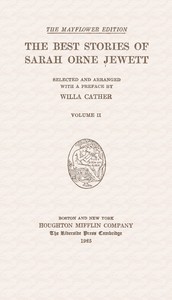
The best stories of Sarah Orne Jewett, Volume 2 (of 2) — Inside the Classic
15
2
Project Gutenberg
2024
Short stories, American; American fiction -- 19th century
Readers of public-domain and historical texts
Project Gutenberg digital edition
en
Edition facts
Words: 67,674
Reading time: 295 min
Text sections: 14
Source:
Project Gutenberg record #74980
This volume collects eleven stories by Sarah Orne Jewett, selected by Willa Cather, including 'A White Heron' and 'The Dulham Ladies.' The excerpts reveal Jewett's focus on rural New England life, with precise observations of character, setting, and social nuance, often centering on women and their quiet rebellions.
Editorial Edition Score
4.8/5
★★★★★
★★★★★
Calculated from edition completeness, EPUB availability, text structure and catalogue metadata. Not a user rating.
Edition quality
Sarah Orne Jewett's stories in this volume, selected by Willa Cather, are rooted in the landscapes and social rhythms of late nineteenth-century New England. The excerpts show a writer attentive to the small but telling details of daily life: the way a cow learns to stand still to avoid its bell, or how a woman's choice to wear a cap or not signals her acceptance of age. Jewett's prose is unhurried, matching the pace of her rural settings, yet it carries a sharp awareness of the constraints and quiet rebellions of her characters, especially women.
The catalog lists this volume under 'Science Fiction & Utopias,' a classification that bears no relation to the content of the stories, which are firmly grounded in realistic, regional fiction. The excerpts offer no hint of speculative elements; instead, they present a world of domestic routines, social expectations, and the natural environment.
The Weight of Routine and the Leaven of Youth
In the excerpt from 'The Dulham Ladies,' Jewett portrays Miss Harriet Pyne as a woman shaped by duty and the company of elders. The narrator notes that she 'had formed all the habits of a serious elderly person' despite being only past thirty. This observation is precise: Jewett links Harriet's behavior to her role as the last unmarried daughter, who 'had been the dutiful companion of her father and mother in their latest years.' The story then introduces a 'light-hearted girl,' Helena Vernon, whose presence acts as a 'little leaven' against the 'priggishness' and 'formalism' of the village. Jewett contrasts the two characters through their attitudes toward social convention: Harriet feels 'cold with apprehension' at the minister's visit, while Helena moves with 'unconscious lovely ease.' The tension between these dispositions—the pull of routine and the disruptive energy of youth—is a recurring dynamic in the volume.
The Natural World as a Character
In 'A White Heron,' the opening paragraphs establish the woods as a living presence. The narrative describes how 'the woods were already filled with shadows' and how the cow's bell 'would not ring' if she stood still, a detail that reveals Jewett's attention to animal behavior. The protagonist, Sylvia, is deeply attuned to this environment: she 'had all the time there was, and very little use to make of it,' and she treats the cow's hide-and-seek as a game. Jewett does not romanticize nature; instead, she presents it as a realm of practical knowledge and mutual accommodation. The girl's familiarity with the path is such that 'their feet were familiar with the path, and it was no matter whether their eyes could see it or not.' This sensory grounding in the natural world contrasts with the social constraints depicted in other stories, suggesting that Jewett uses setting to define her characters' freedoms and limitations.
Social Observation and Historical Context
Jewett embeds her characters in a specific historical moment. In 'The Dulham Ladies,' the narrator comments that 'these days New England life held the necessity of much dignity and discretion of behavior,' and that Miss Pyne 'belonged to the very dullest days of New England.' The passage situates the story between two wars: 'the great impulses of the war for liberty had died away and those of the coming war for patriotism and a new freedom had hardly yet begun.' This framing gives weight to the domestic drama, suggesting that the 'dull interior' of the old house 'typified these larger conditions.' Jewett's social observation is precise: she notes the 'self-conscious hospitality' and the 'inexorable return to asceticism' that followed festivities. The excerpts do not reveal how these tensions resolve, but they establish a world where personal choices—like Helena's guitar and songs—carry implicit social commentary.
Readers approaching this volume should attend to the interplay between Jewett's descriptive precision and her understated social critique. The stories reward attention to small gestures: a shawl in the yard, a cow's stillness, a woman's cap. Cather's selection, though not explained in the excerpts, appears to favor stories that balance character study with a sense of place. The catalog's 'Science Fiction' label is a clear mismatch; these are works of realist fiction grounded in the textures of New England life.
Reader reflection
How will you remember this book?
Save your reaction, strongest insight, and memorable passage.
Your progress
0
/
10
2
Did this book hold your interest?
3
Would you pass this book on to a friend?
4
What was the reading difficulty like?
5
How closely did the book connect with your experience?
6
Would you read this book again?
7
Could you follow the author’s main argument?
8
Did any part of the book stay with you emotionally?
9
Which lesson or insight stayed with you?
10


![Cover of Stepping backwards [Night watches, Part 5.] — Context and Discussion](https://eqopi.com/storage/media/covers/pg12155.jpg)
![Cover of The vigil [Night watches, Part 8.] — Key Ideas to Explore](https://eqopi.com/storage/media/covers/pg12158.jpg)