1

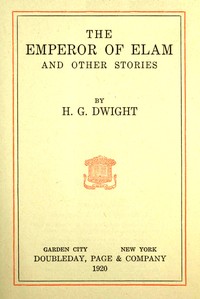
The Emperor of Elam, and other stories — Story, Setting & Ideas
10
1
Project Gutenberg
2023
Short stories, American; American fiction -- 20th century
Readers of public-domain and historical texts
Project Gutenberg digital edition
en
Edition facts
Words: 101,572
Reading time: 442 min
Text sections: 21
Source:
Project Gutenberg record #71279
This collection of 21 stories by H. G. Dwight, originally published between 1903 and 1918, showcases a recurring interest in cultural collisions, ironic dialogue, and the tension between American and European sensibilities. The excerpts reveal a structural pattern of scenes built around verbal sparring and unexpected reversals.
Editorial Edition Score
4.9/5
★★★★★
★★★★★
Calculated from edition completeness, EPUB availability, text structure and catalogue metadata. Not a user rating.
Edition quality
H. G. Dwight's The Emperor of Elam, and other stories (1920) gathers twenty-one tales originally published between 1903 and 1918, many of which were revised for this collection. The excerpts reveal a writer drawn to scenes of cultural friction, where characters from different backgrounds negotiate through sharp dialogue and unspoken assumptions. A recurring structural device is the two-character conversation that escalates into a battle of wits, often with an ironic twist. The stories move between settings—American drawing rooms, European villas, and ambiguous international spaces—but the focus remains on the verbal and psychological maneuvers of the participants.
Dialogue as Duel
The excerpt from “Susannah and the Elder” exemplifies Dwight’s reliance on dialogue to advance plot and reveal character. The conversation between “the Elder” and “the Younger” unfolds as a series of parries: the Elder believes he has secured a romantic understanding by offering a pendant, while the Younger undercuts each assumption with a cooler logic. The exchange is structured like a fencing match—each rejoinder deflates the other’s confidence. Dwight uses italics and dashes to mark shifts in tone, as when the Younger says, “We make love!” with a particular inflection. The scene ends not with resolution but with the Elder turning on his heel, leaving the reader to infer the outcome from the rhythm of the dialogue itself.
Recurring Images of Gifts and Settlements
Throughout the excerpt, material objects—especially gifts—serve as ambiguous tokens of intention. The Elder offers an “antique pendant” as proof of commitment, but the Younger dismisses its significance: “you might give her seventy-three pendants, and I presume her heart is large enough to hang all of them.” This image of jewelry as a hollow symbol recurs in the Younger’s claim that young women accept “necklaces, tiaras, stomachers” as “natural tribute,” no more meaningful than wildflowers. The word “settlements” appears repeatedly, first as a financial term, then twisted into a joke about plural marriage. Dwight uses these recurring motifs to question whether any gesture—material or verbal—can carry stable meaning across cultural boundaries.
Movement Between Scenes and Spaces
The excerpt is divided into three numbered sections, each marking a shift in time or location. Section I establishes the dialogue; Section II begins with “The Elder was visibly annoyed”; Section III opens with “He let several suns go down on a certain stiffness.” These transitions are abrupt, skipping over intervening events and relying on the reader to infer the passage of time. The setting is minimally described—a room, a terrace, an implied Italian or American backdrop—but the movement between scenes is signaled by changes in the characters’ emotional temperature. Dwight often ends a section with a punchline or a gesture, as when the Elder “turned on his heel,” then picks up later with the consequences of that exit.
Cultural Irony and the Unreliable Narrator
The Younger character in “Susannah and the Elder” functions as a kind of internal commentator, offering ironic asides about national customs. He describes his country’s tolerance of plural marriage and its philosophical acceptance of “diamonds or bankruptcy.” The Elder, an outsider, is consistently baffled by these claims, and the reader is left uncertain whether the Younger is teasing, telling the truth, or inventing traditions on the spot. Dwight does not resolve this ambiguity; instead, he lets the irony stand. This technique appears in other stories from the collection, where a character’s authority is subtly undermined by their own rhetoric. The effect is to make the reader question not just the characters’ motives, but the reliability of any cultural explanation offered within the fiction.
Readers approaching this collection will find that Dwight’s stories reward attention to the spaces between lines—the pauses, the unfinished sentences, the gestures that replace speech. The structure often mirrors the content: just as characters fail to fully understand one another, the narrative withholds easy conclusions. It is best to read these tales as a series of tactical encounters, where the real action happens in what is implied rather than stated.
Reader reflection
What did you think of this book?
Answer a few questions and save a private reflection on this device.
Your progress
0
/
10
2
Did this book hold your interest?
3
Would you encourage someone else to read it?
4
How easy was the book to follow?
5
What was its emotional impact?
6
Did the book offer a fresh perspective?
7
Would a second reading be valuable?
8
How understandable was the text?
9
Which lesson or insight stayed with you?
10

![Cover of Stepping backwards [Night watches, Part 5.] — Context and Discussion](https://eqopi.com/storage/media/covers/pg12155.jpg)
![Cover of The vigil [Night watches, Part 8.] — Key Ideas to Explore](https://eqopi.com/storage/media/covers/pg12158.jpg)