1

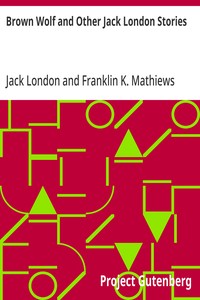
Brown Wolf and Other Jack London Stories Chosen and Edited By Franklin K. Mathiews — Context and Discussion
14
3
Project Gutenberg
2004
Short stories; Wolves -- Fiction
Readers of public-domain and historical texts
Project Gutenberg digital edition
en
Edition facts
Words: 64,327
Reading time: 280 min
Text sections: 7
Source:
Project Gutenberg record #12336
An editorial note on how Jack London's opening, middle, and later stories in this collection guide a first reading, focusing on narrative voice, setting details, and character dynamics.
The collection opens with "Brown Wolf," where a married couple, Walt Irvine and his wife, search for their dog Wolf in an orchard. The wife's practical concern—"Where's Wolf?"—contrasts with Walt's absorption in "the wonder of a bursting almond-bud." This small domestic scene immediately establishes London's attention to sensory detail and the tension between human preoccupations and the natural world. The editor, Franklin K. Mathiews, has selected stories that showcase London's range, from wilderness adventures to moral dilemmas on the water.
Opening with Character and Setting
The first story, "Brown Wolf," introduces a married couple in an orchard, with the wife calling for their dog. London uses the wife's practical concern—"Where's Wolf?"—to contrast with Walt Irvine's absorption in "the wonder of a bursting almond-bud." This small domestic scene establishes London's attention to sensory detail and the tension between human preoccupations and the natural world. The setting is not the wild but a cultivated orchard, suggesting that London's wilderness themes can emerge from everyday life. The wife's "questing glance" and the husband's delayed response hint at a dynamic that may recur in later stories: the interplay between human relationships and the untamed.
Middle Stories: Voices of Experience
In "Yellow Handkerchief," the narrator recounts a conversation with Charley, who advises against a "last raid." The dialogue reveals a mentor-protégé relationship: Charley's concern—"I could never forgive myself if anything happened to you now"—contrasts with the narrator's "cocksureness of youth." London uses first-person narration to convey the tension between youthful bravado and seasoned caution. The passage also includes specific place names—Benicia, Carquinez Straits, Turner's Shipyard—grounding the story in a real geography. The mention of a previous capture and a near-drowning incident suggests a history of danger, but the excerpt does not reveal outcomes, leaving the reader to infer the stakes.
Later Excerpts: Cultural Distance and Choice
In "Nam-Bok," an older woman, Bask-Wah-Wan, refuses her son's offer to join him in his bidarka. She says, "I am old, Nam-Bok, and soon I shall pass down among the shadows. But I have no wish to go before my time." The dialogue emphasizes her fear of the unknown and attachment to her home. London contrasts Nam-Bok's promise of a land "where there are fish and oil in plenty" with the mother's reluctance. The scene ends with a "shaft of light" and a hush among the fisherfolk, creating a moment of stillness. This story explores themes of tradition versus change, and the emotional cost of leaving one's community.
Editorial Design and Reading Path
Franklin K. Mathiews, the editor, states in his introduction that he aimed to collect stories that "serve to exercise both the boy's mind and conscience." The selection moves from a domestic opening to tales of the fish patrol and then to a story set in an Indigenous village. This progression may guide a reader from familiar settings to more distant ones. The editor's note that boys "have too few opportunities to read such books" suggests a pedagogical intent. Readers might notice how London's voice shifts: the close third-person in "Brown Wolf," the first-person in "Yellow Handkerchief," and the more formal narrative in "Nam-Bok." Each story offers a different entry point into London's world.
These excerpts reveal London's skill in using dialogue and setting to create tension. The collection rewards attention to how characters respond to the natural world and to each other. Readers may find it useful to compare the narrative techniques across stories, noting how London adapts his voice to different contexts. The editor's selection emphasizes moral growth and adventure, but the stories themselves resist simple conclusions.
Reader reflection
Your personal reading reflection
Build a private reading journal entry for this title.
Your progress
0
/
10
2
How did the book work for you overall?
3
How likely are you to recommend this book?
4
What was the reading difficulty like?
5
Was the book what you thought it would be?
6
Would you start a conversation about this book?
7
How distinctive were its ideas or approach?
8
How did the pace of the book feel?
9
In one sentence, what did you learn?
10
![Cover of Keeping watch [Night watches, Part 2.] — Story, Setting & Ideas](https://eqopi.com/storage/media/covers/pg12152.jpg)
![Cover of The understudy [Night watches, Part 3.] — A Closer Reading](https://eqopi.com/storage/media/covers/pg12153.jpg)