1

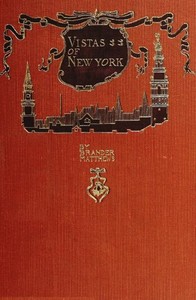
Vistas of New York — Key Ideas to Explore
17
2
Project Gutenberg
2012
New York (N.Y.) -- Fiction; Short stories, American
Readers of public-domain and historical texts
Project Gutenberg digital edition
en
Edition facts
Words: 57,996
Reading time: 253 min
Text sections: 6
Source:
Project Gutenberg record #39434
Brander Matthews' 1912 collection of twelve short stories and sketches captures fleeting moments in turn-of-the-century New York, from hansoms and bob-tail cars to Central Park idylls, with a self-described 'calm observer' lens.
Editorial Edition Score
4.7/5
★★★★★
★★★★★
Calculated from edition completeness, EPUB availability, text structure and catalogue metadata. Not a user rating.
Edition quality
Brander Matthews opens his 1912 collection Vistas of New York with a note that frames the dozen stories as "snapshots or flashlights" of a rapidly changing metropolis. He dates each piece, acknowledging that some details—like the bob-tail car or the hansom cab—were already historical by the time of publication. The earliest story dates back more than a quarter-century, the latest only months before the book appeared. This deliberate dating invites readers to treat each story as a period document, not merely a fictional episode.
The Calm Observer's Lens
Matthews explicitly borrows from Hawthorne the concept of a "calm observer" who watches without interfering. In the excerpt from "In a Hansom" (Chapter VI), the observer's presence is felt through the detailed rendering of a prisoner's ride down Fifth Avenue. The narrative stays close to the man's sensory impressions—the "tinkling chains" of a four-in-hand, the "glaring sunshine," the "arbitrary hats" women wear. The observer does not judge; he records the contrast between the city's vibrant surface and the prisoner's inner desolation. This technique recurs throughout the volume: the author stands aside, letting the city's shifting aspects speak for themselves.
A City in Motion, Captured in Transit
Several stories hinge on journeys through New York's streets. In the excerpt, the hansom cab becomes a moving frame: the prisoner sees Fifth Avenue as "a solid mass of vehicles in ceaseless motion," while the sidewalk crowds remain anonymous. Matthews notes the funeral procession crossing at Thirty-fourth Street—a hearse with a satin-covered coffin, drawn shades—and the prisoner's sudden relief that his parents died young. The city's rhythms—the four-in-hand, the florists' windows, the changing fashions—are not backdrop but active elements that shape the character's mood. The author's note confirms that such details were recorded "in accord with the actual fact at the time."
The Weight of Time and Change
Matthews is acutely aware that his "vistas" are ephemeral. In the preface, he observes that the metropolitan kaleidoscope has revolved so rapidly that some studies "now record what is already ancient history." The excerpt reinforces this: the prisoner reflects on how quickly he will be forgotten—"how many of them would give him a second thought?"—and imagines returning from exile to find no one noticed his absence. The story itself, dated 1894, is already eighteen years old when the collection appears. This layering of temporal perspectives—the character's fear of erasure, the author's acknowledgment of obsolescence—gives the volume a melancholy undertone.
Small Details, Large Implications
Matthews builds his effects through precise, unglamorous particulars. In the excerpt, the prisoner notes "the sweep of the skirt, the curve of the bodice, the grace of gesture, a straggling tendril of hair that had escaped upon the neck." These observations are not decorative; they underscore his impending loss of contact with ordinary life. Similarly, the author's note mentions that family parties no longer bicycle through Central Park—a minor custom that, once gone, signals a vanished era. Readers should watch for such small, concrete details: they are the building blocks of Matthews's method, each one a clue to the social texture of early twentieth-century New York.
Because Matthews dates each story, readers can track how his New York evolves across a quarter-century. The earliest pieces may feel more distant; the later ones edge toward the modern city. Pay attention to the modes of transport—hansoms, bob-tail cars, bicycles—as markers of change. The author's stance as a calm observer means he rarely moralizes; instead, he trusts the reader to see the pathos and humor in these urban vignettes. Approach each story as a self-contained glimpse, not a chapter in a larger plot.
Reader reflection
Before you leave, reflect on the book
Use these questions to collect your thoughts before moving on.
Your progress
0
/
10
2
What was your overall reaction to the book?
3
Would you encourage someone else to read it?
4
How easy was the book to follow?
5
What was the strongest part of the book?
6
Did you gain anything practical from the text?
7
How strong was your personal connection to the text?
8
Would you read this book again?
9
What did this book teach you most?
10


![Cover of Keeping watch [Night watches, Part 2.] — Story, Setting & Ideas](https://eqopi.com/storage/media/covers/pg12152.jpg)
![Cover of The understudy [Night watches, Part 3.] — A Closer Reading](https://eqopi.com/storage/media/covers/pg12153.jpg)