1

The Hands — Reading Notes
13
0
Project Gutenberg
2009
Short stories
Readers of public-domain and historical texts
Project Gutenberg digital edition
en
Edition facts
Words: 3,355
Reading time: 15 min
Text sections: 1
Source:
Project Gutenberg record #29535
A brief, poetic vignette of a godlike creator and his son observing humanity's self-destruction from a mountain, ending with the father molding new clay for a different creation.
Editorial Edition Score
4.3/5
★★★★★
★★★★★
Calculated from edition completeness, EPUB availability, text structure and catalogue metadata. Not a user rating.
Edition quality
Richard Sternbach's The Hands opens with a striking image: a gigantic figure seated atop a mountain, his beard a white flag in the wind, watching distant fires and explosions. The story compresses cosmic scale into a few hundred words, framing creation and destruction as intimate acts. The father's hands—huge yet gentle—scoop clay from a riverbank, while his son pleads for humanity's second chance. The dialogue is spare, the setting elemental: mountain, river, clay, fire. This is not a narrative of action but of gesture and choice.
Scale and Intimacy
The story juxtaposes immense scale with intimate detail. The father is described as a "gigantic figure" who could "dam the river below with a finger," yet his hands are "huge, gentle" as they knead clay. The mountain trembles from explosions a thousand miles away, but the dialogue between father and son is quiet, almost whispered. This contrast between the cosmic and the personal gives the vignette its tension: the fate of a world is decided in a few murmured words and a single gesture.
The Son's Plea and the Father's Silence
The son's role is that of an advocate for humanity, asking repeatedly for another chance. The father's responses are terse: "It would be the same," "They would do it again." The son persists—"Just once more"—but the father only shakes his head. Their exchange is a compressed debate on redemption and human nature. The father's silence after each refusal carries more weight than any explanation. When he finally reaches for clay, the son assumes mercy, but the father corrects him: "Not them." The twist redefines the act not as forgiveness but as a new beginning for something else.
The Hands as Symbol
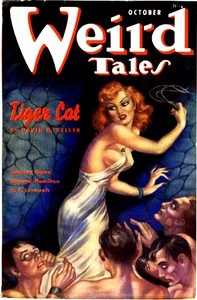
The title The Hands directs attention to the creator's primary tool. Hands are mentioned only at the climax: the father "reached down and scooped up some clay" and held it "in a huge, gentle hand." The act of kneading is described without further detail, leaving the reader to imagine what form will emerge. The hands are both destructive (allowing the old world to burn) and creative (shaping new life). This duality is the story's core: the same hands that let a civilization perish now mold its successor. The illustration by Ray Houlihan likely emphasized this moment, as the text itself centers on the physicality of creation.
The Hands rewards rereading for its economy: every line builds toward the final revelation. Pay attention to the father's beard as a "white flag"—a detail that suggests surrender or truce—and the son's persistent hope. The story's brevity (3355 words) belies its thematic weight. Consider how the author uses the mountain setting as a fixed point of observation, and how the dialogue's rhythm mirrors the father's reluctant decision. This is a fable about the limits of compassion and the necessity of starting over.
Reader reflection
Your personal reading reflection
Build a private reading journal entry for this title.
Your progress
0
/
10
2
How much did you enjoy the reading experience?
3
Is this a title you would suggest to others?
4
How demanding did the text feel?
5
Would this book work well in a reading group?
6
Which element worked best for you?
7
Did the book offer a fresh perspective?
8
Did the book deliver what you hoped for?
9
What is the main idea you are taking away?
10
![Cover of Keeping watch [Night watches, Part 2.] — Story, Setting & Ideas](https://eqopi.com/storage/media/covers/pg12152.jpg)
![Cover of The understudy [Night watches, Part 3.] — A Closer Reading](https://eqopi.com/storage/media/covers/pg12153.jpg)