1

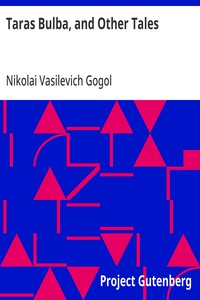
Taras Bulba, and Other Tales — Context and Discussion
12
3
Project Gutenberg
1998
Short stories; Russia -- Fiction
Readers of public-domain and historical texts
Project Gutenberg digital edition
en
Edition facts
Words: 113,646
Reading time: 495 min
Text sections: 12
Source:
Project Gutenberg record #1197
Gogol's collection blends Cossack epic, supernatural folklore, and bureaucratic satire. The title story follows Taras Bulba, while tales like 'The Cloak' and 'St. John's Eve' showcase his shift from romanticism to grim realism, with precise observations on voice, structure, and recurring motifs.
Editorial Edition Score
4.8/5
★★★★★
★★★★★
Calculated from edition completeness, EPUB availability, text structure and catalogue metadata. Not a user rating.
Edition quality
Gogol's collection opens with a Cossack epic that immediately establishes a world of violent honor and martial camaraderie. The narrative voice in 'Taras Bulba' is sweeping and declamatory, contrasting sharply with the sly, ironic tone of 'The Cloak,' where the narrator hedges details ('in a certain department') to mock bureaucratic pettiness. This tonal range—from heroic bombast to deadpan satire—is the collection's defining structural feature.
Cossack Epic and Narrative Scale
'Taras Bulba' occupies the first twelve chapters and is the collection's longest work. Its prose is deliberately archaic, with extended similes and a choral voice that amplifies battle scenes. The narrator frequently addresses the reader directly, as when describing the Cossacks' 'free Cossack soul'—a phrase that recurs in John Cournos's introduction. The story's scale is epic: it spans years, covers vast steppe landscapes, and culminates in a siege. Yet the excerpts show Gogol grounding this grandeur in concrete sensory details, such as the 'smoke-blackened chimneys' and 'burning coals over the steppe' in 'St. John's Eve.' This juxtaposition of mythic ambition with earthy specificity is a hallmark of Gogol's method.
Supernatural Intrusions and Folk Belief
'St. John's Eve' and 'The Mysterious Portrait' introduce supernatural elements that disrupt everyday reality. In 'St. John's Eve,' the devil Basavriuk appears in folkloric guise—a sheep's head with a 'black, bristling moustache' that makes 'a significant gesture.' The narrative voice here is that of a folk tale, with phrases like 'my late grandfather's aunt said' and 'you may laugh, but it was no laughing matter.' This oral storytelling style contrasts with the detached irony of 'The Cloak.' The supernatural is not merely decorative; it serves as a vehicle for moral commentary, as when the devil seduces the young to 'unearth treasures.' Gogol uses these intrusions to probe the boundary between the mundane and the diabolical, a theme that recurs in 'The Portrait.'
Bureaucratic Absurdity and the Grotesque
'The Cloak' exemplifies Gogol's shift toward social satire. The opening paragraph parodies officialdom's hypersensitivity: 'Each individual attached to them nowadays thinks all society insulted in his person.' The protagonist, a lowly official described as 'short of stature, somewhat pock-marked, red-haired, and short-sighted,' is rendered with clinical precision. The narrative voice adopts a mock-sympathetic tone, detailing the character's trivial existence. This story's structure—a gradual accumulation of absurd detail leading to a supernatural or pathetic climax—mirrors the pattern in 'How the Two Ivans Quarrelled,' where a petty dispute escalates into a lifelong feud. Gogol's grotesque emerges from the collision of minute realism with irrational behavior, as when a trough 'putting its arms akimbo' dances across a cottage.
Readers approaching this collection should attend to Gogol's narrative voices: the bardic tone of the Cossack tales, the folkloric register of the supernatural stories, and the ironic detachment of the Petersburg tales. These shifts are not arbitrary but reflect Gogol's deliberate exploration of genre and perspective. The catalog subjects 'Short stories; Russia -- Fiction' only hint at the range; the excerpts reveal a writer constantly testing the limits of realism and romance.
Reader reflection
What was your reading experience?
Capture what you thought, learned, and would like to remember.
Your progress
0
/
10
2
How much did you enjoy the reading experience?
3
Would you encourage someone else to read it?
4
How easy was the book to follow?
5
Is this a title worth rereading?
6
Did any part of the book feel personally relevant?
7
How valuable was this book for your own interests?
8
Did the book meet your expectations?
9
In one sentence, what did you learn?
10
![Cover of Keeping watch [Night watches, Part 2.] — Story, Setting & Ideas](https://eqopi.com/storage/media/covers/pg12152.jpg)
![Cover of The understudy [Night watches, Part 3.] — A Closer Reading](https://eqopi.com/storage/media/covers/pg12153.jpg)