1

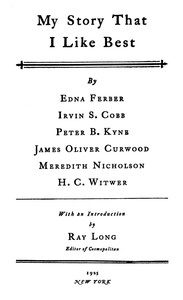
My Story That I Like Best — Background and Themes
14
2
Project Gutenberg
2021
Short stories, American; American fiction
Readers of public-domain and historical texts
Project Gutenberg digital edition
en
Edition facts
Words: 59,436
Reading time: 259 min
Text sections: 6
Source:
Project Gutenberg record #65906
Six early 20th-century popular authors each select their own favorite story, introduced by Cosmopolitan editor Ray Long. The collection includes Edna Ferber, Irvin S. Cobb, Peter B. Kyne, James Oliver Curwood, Meredith Nicholson, and H. C. Witwer, with a preface framing the volume as an intimate literary gathering.
Editorial Edition Score
4.7/5
★★★★★
★★★★★
Calculated from edition completeness, EPUB availability, text structure and catalogue metadata. Not a user rating.
Edition quality
Ray Long, editor of Cosmopolitan magazine, introduces this 1925 collection by imagining himself as a host inviting six popular writers to discuss their own work. The premise is unusual: each author was asked to choose the story they liked best from their own output. Long’s introduction sets a conversational tone, describing the authors in physical detail—Irvin Cobb’s “two chins in front and a spare in the rear,” Peter B. Kyne’s “face and figure of a well-fed priest”—and attributing their success to a simple formula: “Think better and work harder than your competitor.”
A Host’s Framing and the Authors’ Personas
Long’s introduction does more than list credentials; it paints each writer as a distinct personality. Edna Ferber is “black-haired, dark-eyed, vivid, animation itself”; James Oliver Curwood is “tall, wiry, outdoorsy in every line and movement.” The editor explicitly compares the authors’ names to “trade-marks for interesting, satisfying reading matter,” suggesting that commercial success and literary quality were intertwined in the magazine marketplace of the 1920s. The framing device—an evening of relaxed conversation—implies an intimacy that the reader is invited to share.
The Excerpt’s Focus: Dan Pelly and Tiny Tim
The longest excerpt comes from Peter B. Kyne’s story “Point,” featuring an aging dog trainer named Dan Pelly and his unlikely pointer, Tiny Tim. The narrative dwells on the physical details of the dog’s appearance—described as a “mutt”—and the trainer’s emotional attachment. Dan registers at a hotel with “his dog, Tiny Tim,” and procures a “hearty ration of lamb stew with vegetables” for the animal. The story builds toward a field trial where Tiny Tim is paired against a celebrated pointer, Colonel Dorsey. The excerpt shows a strong sense of place (a village square, a hotel lobby, a sage flat) and a community of trainers who speak in colloquial, affectionate banter.
Catalog Subjects vs. Actual Content
The catalog lists this work under “Short stories, American” and “American fiction,” with secondary topic “general-literature.” The excerpts confirm the short-story format but reveal a specific editorial structure: each author’s contribution is preceded by a personal statement about why they chose that story. The introduction by Ray Long is itself a substantial piece of magazine-style commentary. The excerpt from Kyne’s “Point” is not a complete story but a portion that emphasizes character and setting over plot resolution. The catalog subjects do not capture the meta-literary framing—the authors’ own preferences and the editor’s role—which is a central feature of the book.
Readers approaching this collection should note that the excerpts provide only fragments of the six stories. The editorial apparatus—Long’s introduction and each author’s prefatory note—is as much a part of the book as the fiction itself. The volume offers a window into the tastes and self-perceptions of commercially successful American writers of the 1920s, filtered through the lens of a magazine editor who valued personality and productivity.
Reader reflection
What did you think of this book?
Answer a few questions and save a private reflection on this device.
Your progress
0
/
10
2
Did this book hold your interest?
3
Would you pass this book on to a friend?
4
Did the language feel accessible?
5
Would you read this book again?
6
Did you gain anything practical from the text?
7
What did you appreciate most?
8
How did the pace of the book feel?
9
What did this book teach you most?
10
![Cover of Keeping watch [Night watches, Part 2.] — Story, Setting & Ideas](https://eqopi.com/storage/media/covers/pg12152.jpg)
![Cover of The understudy [Night watches, Part 3.] — A Closer Reading](https://eqopi.com/storage/media/covers/pg12153.jpg)