1

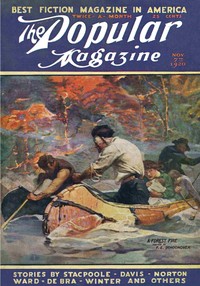
The man who talked too much — Themes and Context
12
1
Project Gutenberg
2023
Short stories; Voyages and travels -- Fiction
Readers of public-domain and historical texts
Project Gutenberg digital edition
en
Edition facts
Words: 10,110
Reading time: 44 min
Text sections: 1
Source:
Project Gutenberg record #71388
Roy Norton's short story follows two taciturn prospectors, David and Goliath, who reluctantly aid a verbose stranger named Lucky Cochran after his loose talk leads to trouble. The narrative shifts from a slow train journey to a tense shipboard confrontation, with dialogue and pacing revealing character.
Editorial Edition Score
4.4/5
★★★★★
★★★★★
Calculated from edition completeness, EPUB availability, text structure and catalogue metadata. Not a user rating.
Edition quality
The story opens on a westbound Santa Fe train, where two seasoned prospectors—a giant and a red-headed runt known as David and Goliath—sit in weary silence. Their boredom is broken by a garrulous stranger, Lucky Cochran, who talks too much and too freely. Norton establishes character through contrast: the partners' terse, wary speech against Cochran's self-important chatter. The setting, a smoking car crossing barren scenery, mirrors the men's internal restlessness. The narrative voice is lean, favoring action and dialogue over description, and the pace quickens as Cochran's boasting leads to a card game and a chase.
Voice and Dialogue as Characterization
Norton uses dialogue to define his three principals without authorial comment. Cochran's speech is effusive and self-congratulatory: he introduces himself as “Lucky Cochran” and assumes his fame precedes him. David and Goliath reply in monosyllables or grudging phrases—“Nope. Can't say I ever did.” The partners' laconic exchanges reveal their shared history and distrust of talk. When Cochran later confesses he was swindled, his tone shifts to doleful humility, while David's commands become clipped and authoritative. The contrast in speech patterns drives the story's tension and humor.
Pacing from Languor to Action
The first half of the excerpt moves at a deliberate, almost static pace. The train's “snail's pace” and the partners' exhaustion create a sense of inertia. Cochran's arrival injects energy, but the real acceleration comes when the setting shifts to a ship. The gangplank falls, and the narrative tightens: David and Goliath confront the card sharpers, and the action becomes compressed in time. Norton uses short sentences and rapid exchanges—“Just a minute. I want to talk to you two fellers.”—to heighten urgency. The wait for Cochran and the mate's intervention stretch the tension before the climax.
Recurring Motifs of Silence and Speech
Silence is as telling as speech. The partners' initial boredom stems from exhausted conversation; they are “men of still places.” Cochran's verbosity is a magnet for trouble—Goliath explicitly blames his talking for the swindle. When David and Goliath take charge, they impose silence on the crooks: “the less you have to say the better it'll be for you.” The story's moral is embedded in its structure: talk invites risk, while restraint commands respect. Even the title's irony is borne out by Cochran's final humility, though the partners' own taciturnity proves more effective.
Readers should attend to how Norton balances exposition with dialogue. The story's brevity (under 11,000 words) rewards attention to its shifts in tempo and the weight given to each character's voice. The incomplete excerpt leaves the resolution uncertain, but the pattern of cause and effect—talk leads to trouble, silence to control—is firmly established.
Reader reflection
How will you remember this book?
Save your reaction, strongest insight, and memorable passage.
Your progress
0
/
10
2
Did this book hold your interest?
3
Is this a title you would suggest to others?
4
Did the language feel accessible?
5
What was its emotional impact?
6
How strong was your personal connection to the text?
7
Did you gain anything practical from the text?
8
Which element worked best for you?
9
Which lesson or insight stayed with you?
10
![Cover of Keeping watch [Night watches, Part 2.] — Story, Setting & Ideas](https://eqopi.com/storage/media/covers/pg12152.jpg)
![Cover of The understudy [Night watches, Part 3.] — A Closer Reading](https://eqopi.com/storage/media/covers/pg12153.jpg)