1

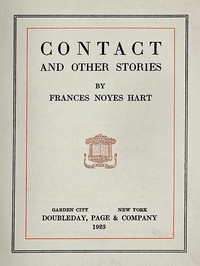
Contact, and Other Stories — Text and Context
12
0
Project Gutenberg
2020
Short stories, American; Man-woman relationships -- Fiction
Readers of public-domain and historical texts
Project Gutenberg digital edition
en
Edition facts
Words: 77,575
Reading time: 338 min
Text sections: 13
Source:
Project Gutenberg record #61138
Frances Noyes Hart's 1923 collection uses precise diction and layered dialogue to explore post-WWI emotional landscapes, contrasting brittle social surfaces with wounded interior lives in stories like 'Contact!' and 'Green Gardens.'
Editorial Edition Score
4.8/5
★★★★★
★★★★★
Calculated from edition completeness, EPUB availability, text structure and catalogue metadata. Not a user rating.
Edition quality
Frances Noyes Hart opens 'Contact!' with a silk-hung drawing room in Curzon Street, where the protagonist Janet receives a shabby packet of letters. The scene establishes a pattern of restrained emotion: Janet 'looked every one of her thirty years—and mortally tired—and careless of both facts.' Hart’s diction here is economical yet evocative, pairing physical detail with psychological distance. The dialogue that follows, between Janet and the younger Rosemary, reveals a deliberate contrast between the 'frightfully exciting Western novel' and Janet’s own Western origins—a wry self-awareness that recurs across the collection.
Diction of Displacement
Hart frequently uses sensory language to evoke a sense of loss and dislocation. In 'Contact!,' the phrase 'Victory clothes' is immediately undercut by the parenthetical 'even when their poor hearts went in black.' The juxtaposition of scarlet and silver with mourning hints at the collection’s preoccupation with surfaces that mask grief. Similarly, in the excerpt from 'Green Gardens,' the narrator describes 'the happy noises of small things tucking themselves away for the night'—a deceptively simple image that precedes a confession of 'black torture.' Hart’s word choices often carry a double weight: the 'dirty place' of a Berlin café contrasts with 'the deep meadows we had lost,' and the verb 'fastened itself around me like a vise' gives the remembered poem a physical, almost violent grip.
Dialogue as Mask and Revelation
Hart’s characters speak in layered exchanges that reveal more than they state outright. In 'Contact!,' Janet’s reply to Rosemary—'I come from that frightfully exciting West, and I know all about the pet rattlesnakes and the wildly Bohemian cowboys'—is a polite deflection that also signals her weariness with stereotype. Later, Stephen’s confession to Daphne in 'Green Gardens' shifts from a quoted poem to a raw, fragmented account: 'I went mad with pride and shame, and swore I’d drag their precious name through the dirt of every country in the world.' The dialogue here moves from literary quotation to visceral memory, and Hart marks the transition with a change in address—from 'little Golden Heart' to a direct, unguarded plea. The effect is that of a mask slipping, but only partially.
Recurring Motifs of Memory and Place
Across the excerpts, specific places become anchors for memory and longing. In 'Contact!,' the drawing room and the shabby packet of letters serve as triggers for past experience. In 'Green Gardens,' the title itself becomes a refrain: Stephen recalls 'the sun-dial, with the roses on it, warm in the sun,' and 'the cresses by the brook, cool and green and wet.' Hart uses these sensory details to ground abstract emotion in the physical world. The poem quoted—Rupert Brooke’s 'The Old Vicarage, Grantchester'—functions as a shared cultural touchstone, but Hart personalizes it: Stephen’s memory of 'the deep meadows we had lost' echoes Brooke’s lines but is refracted through his own history of exile and shame. The motif of 'honey still for tea' recurs as a question about whether beauty and innocence survive trauma.
Structure and the Unfinished Confession
Hart often structures scenes around a confession that is interrupted or incomplete. In 'Contact!,' the narrative cuts away just as Janet receives the letters, leaving the reader to infer their significance. In 'Green Gardens,' Stephen’s account of his past is broken by Daphne’s interjection—'But why couldn’t you come back to Green Gardens?'—and his response trails off into repetition: 'And I did—and I did.' The ellipses and dashes in the text mirror the fractured nature of memory and trauma. Hart resists tidy resolution; instead, she lets the emotional weight accumulate through what is left unsaid. This structural choice aligns with the collection’s broader interest in the limits of language to convey suffering, and the ways in which characters circle around painful truths without fully articulating them.
Readers attentive to Hart’s craft will notice how she uses small, concrete details—a rose-red cushion, a shabby packet, the smell of clove pinks—to anchor moments of intense emotion. Her dialogue rewards close reading: what characters do not say often matters as much as what they do. The collection’s title, 'Contact,' hints at the difficulty of genuine connection in a world shaped by war and loss. These stories do not offer easy comfort, but they repay the patience of a reader willing to listen for the silences between the words.
Reader reflection
Your personal reading reflection
Build a private reading journal entry for this title.
Your progress
0
/
10
2
How much did you enjoy the reading experience?
3
Is this a title you would suggest to others?
4
Did the language feel accessible?
5
How much did the book move you?
6
How would you describe its reading pace?
7
Would you like to discuss this book with someone?
8
Did anything about the book feel genuinely new?
9
What did this book teach you most?
10

![Cover of Keeping watch [Night watches, Part 2.] — Story, Setting & Ideas](https://eqopi.com/storage/media/covers/pg12152.jpg)
![Cover of The understudy [Night watches, Part 3.] — A Closer Reading](https://eqopi.com/storage/media/covers/pg12153.jpg)