1

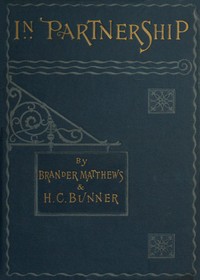
In Partnership: Studies in story-telling — Reading Notes
8
1
Project Gutenberg
2016
Short stories, American; American fiction -- 19th century
Readers of public-domain and historical texts
Project Gutenberg digital edition
en
Edition facts
Words: 57,602
Reading time: 251 min
Text sections: 7
Source:
Project Gutenberg record #53729
A collaborative collection of short stories by Brander Matthews and H. C. Bunner, featuring narrative experiments with documents, dialogue, and multiple perspectives. The opening story uses obituaries, IOUs, and letters to unravel a mystery, while later tales employ ironic contrasts and unspoken thoughts.
Editorial Edition Score
4.7/5
★★★★★
★★★★★
Calculated from edition completeness, EPUB availability, text structure and catalogue metadata. Not a user rating.
Edition quality
The opening story, 'The Documents in the Case,' immediately signals this collection's interest in narrative form. It begins not with a narrator's voice but with an obituary from the Illustrated London News, followed by IOUs and letters. The plot is assembled from these fragments, as if the reader is a detective piecing together a life. This method recurs throughout the book: stories are built from conversations, private thoughts, and contrasting viewpoints. The authors often let characters' inner monologues contradict their spoken words, as when Dear Jones and Baby Van Rensselaer think 'What in the name of the prophet does the Duchess mean by introducing me to More Girls?' while politely murmuring about the weather. Such structural playfulness is the collection's defining trait.
Documents as Storytelling Devices
The first story relies entirely on documentary evidence: an obituary, promissory notes, and presumably letters (though only excerpts are provided). The obituary notes that Sir William Beauvoir's eldest son 'left England suddenly for America' and that 'much forgotten gossip will now in all probability be revived.' The IOUs from 1848 show debts of £105 and £250, signed by 'William Beauvoir, junr.' This method forces the reader to infer character and motive from dry records. The authors trust that a list of debts and a family notice can generate suspense. Later stories use different documentary forms: in 'The Seven Conversations of Dear Jones and Baby Van Rensselaer,' the narrative is built from dialogue and unspoken reactions, with the authors explicitly marking what is said versus what is thought. This structural variety suggests a deliberate exploration of how stories can be told through non-traditional means.
Unspoken Words and Ironic Contrasts
In 'The Seven Conversations,' the authors print characters' polite exchanges alongside their blunt inner thoughts. Dear Jones thinks 'More Girls' while saying 'Miss Van Rensselaer'; Baby Van Rensselaer mentally dismisses him as a 'slim young man.' This technique creates dramatic irony and reveals the gap between social performance and private feeling. The story also includes a scene where a character, Horace, saves a woman from a train wreck, only to learn she has just married another man. The narrative states: 'his narrow white bed knows all that I cannot tell of his tears and his broken dreams.' Here, the authors withhold direct emotion, letting the bed stand in for grief. Such restraint contrasts with the earlier, more explicit irony, showing a range of tonal control.
Collaborative Voice and Authorial Play
Because Matthews and Bunner wrote together, the collection raises questions about joint authorship. The table of contents attributes some stories to one author and others to both. 'The Documents in the Case' and 'The Seven Conversations' are co-written, while 'Venetian Glass' is by Matthews alone and 'The Red Silk Handkerchief' by Bunner. Yet the co-written pieces do not read as two voices stitched together; they maintain a consistent tone. The authors also play with reader expectations: the obituary in the first story is presented as a real document, but its inclusion in a fiction collection blurs fact and invention. The story's subtitle 'Part First' and the numbered documents suggest a case file, but the narrative eventually shifts to more conventional storytelling. This self-consciousness about form is a thread running through the book.
Readers should attend to how each story constructs its world: through letters, overheard remarks, or the collision of public and private selves. The authors are less interested in plot twists than in the mechanics of revelation. The collection rewards attention to its framing devices and the spaces between what is said and what is meant.
Reader reflection
What did you think of this book?
Answer a few questions and save a private reflection on this device.
Your progress
0
/
10
2
Did this book hold your interest?
3
Would you recommend this book to another reader?
4
Did the language feel accessible?
5
Did the book deliver what you hoped for?
6
Was the book moving at the right speed?
7
How useful did the reading feel?
8
How strong was your personal connection to the text?
9
What is the main idea you are taking away?
10

![Cover of Keeping watch [Night watches, Part 2.] — Story, Setting & Ideas](https://eqopi.com/storage/media/covers/pg12152.jpg)
![Cover of The understudy [Night watches, Part 3.] — A Closer Reading](https://eqopi.com/storage/media/covers/pg12153.jpg)