1

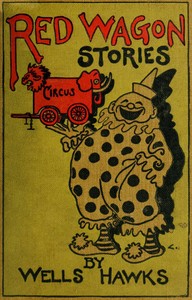
Red Wagon Stories; or, Tales Told Under the Tent — Key Ideas to Explore
15
2
Project Gutenberg
2017
Short stories, American; Circus -- Fiction
Readers of public-domain and historical texts
Project Gutenberg digital edition
en
Edition facts
Words: 20,665
Reading time: 90 min
Text sections: 3
Source:
Project Gutenberg record #55622
A collection of linked tales told by circus workers between shows, using vernacular dialogue and a frame narrative set under the tent. The stories shift between reminiscence and performance, with recurring motifs of music, crowd manipulation, and the rough camaraderie of traveling show life.
Editorial Edition Score
4.5/5
★★★★★
★★★★★
Calculated from edition completeness, EPUB availability, text structure and catalogue metadata. Not a user rating.
Edition quality
The frame of Red Wagon Stories is established in its opening lines: seven members of a circus outfit gather around the ring bank and carpet pads between shows, and the tales they tell are presented as a series of linked monologues. The narrative voice is consistently colloquial, with each speaker identified by his role—Press Agent, Candy Butcher, Band Master—and given a distinct vernacular. The setting is not merely decorative; the physical details of the tent, the ring, and the dressing area recur, anchoring the stories in a specific, transient space. The dedication to bare-footed kids who sneaked to the circus lot signals a nostalgic undercurrent, but the tales themselves are rough-edged, focused on the mechanics of the show and the personalities behind it.
The Frame and the Voices
The book opens with a brief description of the gathering: seven circus workers sit on the ring bank and carpet pads, talking between shows. This frame is minimal but effective, establishing a communal storytelling context. Each subsequent section is attributed to a specific speaker—the Press Agent, the Candy Butcher, the Band Master—and the dialogue is rendered in a heavy vernacular that varies slightly from speaker to speaker. The Press Agent, for instance, boasts of his past as a dramatic critic and speaks in a rapid, self-aggrandizing style: “Art must be preserved, an’ the only way to do it is by knockin’.” The Candy Butcher is described as “the best dressed man in the outfit,” and his speech carries a different cadence. The frame never intrudes beyond the opening and occasional interjections, leaving the tales to stand as oral performances.
Music as Plot and Texture
Music is a recurring element, not just as background but as a driver of action. The Band Master’s story centers on a performance of “The Holy City” that is abruptly switched to “Here Comes a Sailor” when Admiral Dewey arrives, causing a performer to lose his balance and nearly break his back. The anecdote highlights the band’s precision and the director’s quick thinking, but also the physical risks of such improvisation. Another tale describes a medicine show where the band plays loudly to drown out a patient’s screams during a tooth extraction. The drummer Cooney is later lassoed off a wagon by a disgruntled Indian performer, drums and all, into a herd of cows. These episodes use music as a structural device—a cue for action, a cover for deception, a source of conflict.
Recurring Images of the Show's Machinery
The excerpts are dense with specific props and equipment: the Greaser Knife Thrower’s box of steels, the guy rope for the net under the swings, the ticket wagon window, the blue boards of the stands. These details are not merely atmospheric; they ground the stories in the physical labor of the circus. The Press Agent carries “a ream of adjective hit paper, two lead pencils, and a pass-pad.” The Candy Butcher’s creased pants are noted regardless of the town. The Boss Canvasman ties a knot while listening. The setting is never idealized; it is a working environment where injuries, fines, and rivalries are routine. The recurring image of the empty tent between shows—the “big round top when the tent was empty”—frames the tales as moments of rest and reflection within a demanding schedule.
Movement Between Scenes and Speakers
The structure of the book relies on shifts between different speakers and their stories, but the excerpts show that these transitions are not abrupt. In the Band Master’s tale, the Boss Canvasman interjects with a question, and the Band Master responds, creating a sense of ongoing conversation. The Candy Butcher’s story is introduced with a physical description before he begins speaking. This technique keeps the frame alive even during the monologues. The movement is also spatial: characters enter through red curtains, sit on boxes, or walk across the track. The narrative eye moves from the ring to the dressing tent to the parade route, mirroring the restless energy of the show itself. The result is a collection that feels less like isolated yarns and more like a single, extended evening of talk under the tent.
Readers approaching Red Wagon Stories should listen for the distinct voices of each storyteller and note how the physical setting—the ring, the ropes, the props—shapes the anecdotes. The book rewards attention to the mechanics of performance, both onstage and off. The tales are best read as a sequence, allowing the recurring motifs of music, crowd control, and backstage rivalry to accumulate. The incomplete excerpts leave the full arc of the collection unclear, but the pattern of linked monologues suggests a deliberate, episodic structure that mirrors the itinerant life it depicts.
Reader reflection
Your personal reading reflection
Build a private reading journal entry for this title.
Your progress
0
/
10
2
How much did you enjoy the reading experience?
3
Is this a title you would suggest to others?
4
How much effort did this book require?
5
Did the book deliver what you hoped for?
6
Did the book offer a fresh perspective?
7
Did you relate to its people, ideas, or situations?
8
How useful were the ideas in this book?
9
In one sentence, what did you learn?
10

![Cover of Keeping watch [Night watches, Part 2.] — Story, Setting & Ideas](https://eqopi.com/storage/media/covers/pg12152.jpg)
![Cover of The understudy [Night watches, Part 3.] — A Closer Reading](https://eqopi.com/storage/media/covers/pg12153.jpg)